How to Rescue Failing AI Initiatives
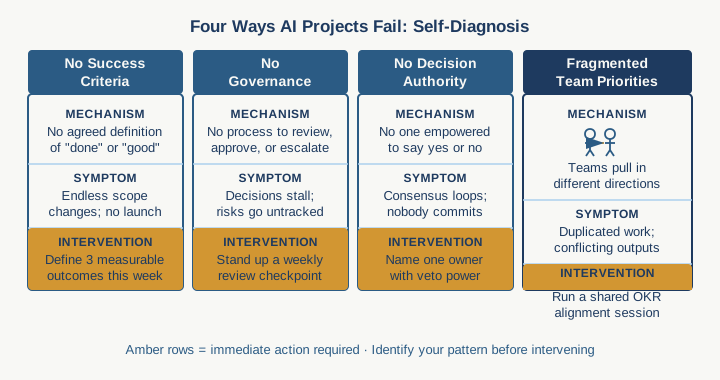
Most AI initiatives fail not because the technology broke, but because the project itself was never managed like a project. If your AI initiative is stalling, the diagnosis matters before you fix anything. Most failing AI projects die from one of four mechanisms—and they require completely differen

Most AI initiatives fail not because the technology broke, but because the project itself was never managed like a project. No clear success criteria. No real governance. No one empowered to make a decision when the situation changed. And by the time leadership noticed, the team had already splintered into sub-groups with competing priorities and mounting resentment.
If you're managing a failing AI initiative right now, this is your signal to stop treating it like an experiment and start treating it like the delivery challenge it actually is.
The diagnosis matters before you fix anything. Most failing AI projects die from one of four mechanisms, and they require different interventions.
Technical debt disguised as a feature gap. The team has built or is building something that works in isolation but does not integrate cleanly with how your organization actually operates. This one is salvageable but expensive; it usually means pausing new feature work and doing serious plumbing.
Scope creep without a scope reset. The project started with a clear goal: automate status reporting, improve forecast accuracy, whatever it was. Then leadership asked for "more AI" without defining what that means. The team added features no one asked for. Delivery dates slid. Stakeholders lost faith.
Misaligned success metrics. Everyone agreed the project was important. No one agreed on what success looked like. Is it adoption rate? Time saved? Better predictions? Cost reduction? If you haven't heard the same success metric from three different stakeholders, you haven't really defined it.
Team capability erosion. The people who understood the original vision left or were reassigned. New people inherited a half-built thing with no context. Knowledge lives in Slack threads and forgotten Confluence pages. Every decision takes twice as long because the team does not trust its own history.
Start here: which one is actually killing your project? Have the conversation with your sponsor and your team lead separately. You will probably hear different answers. That misalignment is itself a failure point you need to surface and fix.
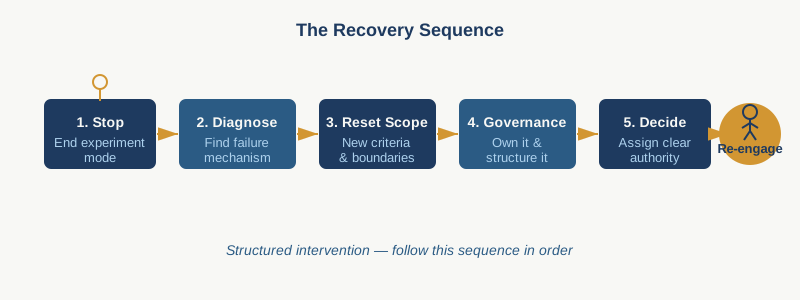
Once you know what broke, the rescue has three parts.
First, reset scope and success metrics in a way that restores credibility. This means going back to your steering committee or sponsor with a hard conversation: "Here is what we learned. Here is what we thought success looked like. Here is what it actually needs to be. And here is what we ship in the next 90 days to prove we know the difference."
The key here is specificity. Not "improved efficiency." Not "better insights." Name the exact stakeholder problem the AI work actually solves. "Sales leaders spend six hours a week tracking project health across three systems. This tool consolidates that into one dashboard and cuts that time to ninety minutes." That is a metric you can measure and a benefit you can defend.
Second, rebuild the team structure so people know who owns what and how decisions actually get made. Failing AI projects often have unclear handoffs between technical and business stakeholders. The data engineer thinks the business analyst owns adoption. The business analyst thinks the technical lead owns user experience. No one owns the whole thing.
Establish a weekly steering rhythm, not a status meeting, a decision meeting. One hour. Same people. You walk through the RAID log, the change requests, the blockers. You make the call on what ships and what waits. You communicate that decision to the team before you leave the room. Clarity kills a lot of the friction that makes projects feel doomed.
Third, introduce staged checkpoints that let you catch problems before they metastasize. This looks like: every two weeks, the team demos something tangible. Every four weeks, you review against your success metrics. Every eight weeks, you do a gate review where stakeholders decide whether to continue, pivot, or stop. These are not checkboxes. They are decision points where you have permission to change direction without it feeling like failure.
The tool that usually matters here is your project or program dashboard, whether that is Jira, Monday, Smartsheet, or something else. But the dashboard only works if it reflects reality. Three things have to be visible in real time: where you are against the original plan, what is blocking progress, and whether your success metrics are moving in the right direction. If your dashboard is a pretty thing no one looks at, rebuild it to answer the question your sponsor actually cares about: "Are we going to ship something valuable, and when?"
One honest limitation: project governance does not fix technical debt. If the problem is a poorly architected solution that cannot integrate cleanly with your existing systems, better meetings will not save you. You will eventually have to make a bigger decision: rebuild, buy instead, or sunset the work. But governance will get you to that decision faster and with less wasted effort.
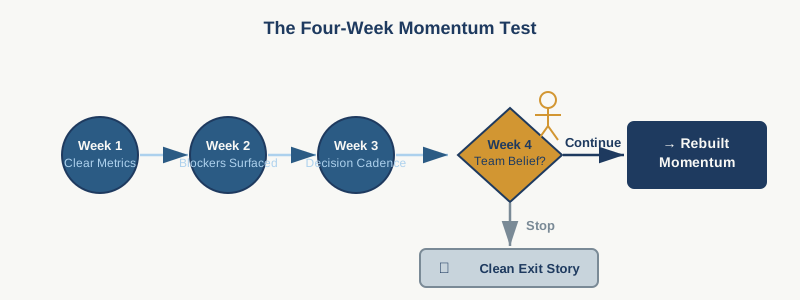
Run this for four weeks. Weekly decision meetings. Clear success metrics. Visible blockers. At week four, ask your team: Do you believe this can work? Do you want to keep going? If the answer is no, you have just saved yourself months of slow failure and you have a clear story to tell leadership about why. If the answer is yes, you have rebuilt enough momentum that people will actually carry it through to launch.
Practical AI intelligence for project managers. Weekly, free. Get frameworks, tools, and decisions that help you stay ahead of AI adoption on your projects. No hype. No filler. Subscribe free →
Not sure which AI tools to trust on your projects? Download the free AI Tool Evaluation Checklist: 12 questions PMs ask before approving any AI tool for their team. Download free →