The Hidden Assumptions Behind Every AI Project Forecast
You asked your AI project planning tool for a delivery forecast. It gave you a date.
You asked your AI project planning tool for a delivery forecast. It gave you a date. The team nodded. You committed to your steering committee. Then halfway through the project, everything shifted.
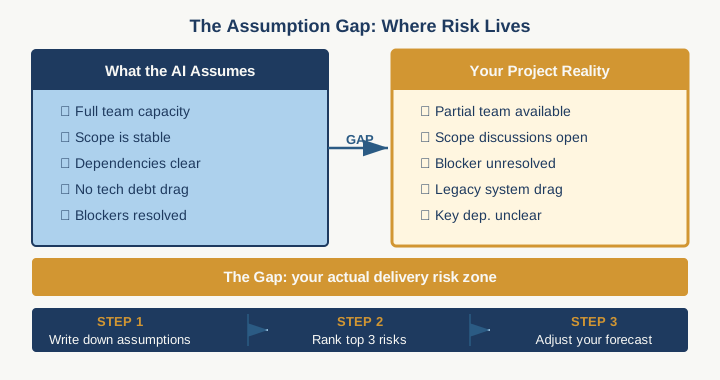
The forecast wasn't wrong, exactly. It was incomplete. Behind that confident date sat a cluster of assumptions nobody ever surfaced, let alone stress-tested. The tool assumed your team would stay at full capacity. That scope wouldn't creep. That dependencies would resolve on schedule. That technical debt wouldn't slow you down. None of those things were stated. They were just baked in, invisible, and almost certainly false for your specific project.
This is the quiet qualifier that derails more delivery plans than any technical failure. Every AI projection, from timeline estimates to resource forecasts to budget predictions, carries hidden assumptions. Your job as a PM is not to trust the precision. It is to hunt for what had to be true for that projection to work, and ask yourself: is any of that actually true in my world?
The problem starts with how AI tools present their work. They generate specific numbers. Fourteen days. 87% confidence. 23 person-hours. The precision is seductive. It looks like certainty. Your brain treats it like certainty. A spreadsheet with exact figures feels more authoritative than a range with honest uncertainty built in. So you anchor on the number, repeat it in meetings, and commit to it with stakeholders. By the time you realize the assumptions were shaky, you are already defending a miss.
This is not a flaw in the AI. It is a feature of how our brains process information. Precision feels like knowledge even when it is really just specificity. The tool is doing what you asked: giving you a forecast. It is your job to reverse-engineer the confidence behind that forecast before you treat it like a contract.
Here is how to spot the hidden qualifier before it becomes a delivery problem.
First, ask the tool to show its assumptions. Most AI project tools can tell you what variables they used to generate an estimate. In Copilot, ChatGPT, or Gemini, you can prompt directly: "What assumptions did you make about team capacity, scope stability, and dependency timing when you generated that timeline?" Write down the answer. Do not trust your memory of what was said. Get it in writing.
Second, hold those assumptions up to your actual project. Is your team really at full capacity, or are people split across initiatives? Will scope actually hold, or have you had three change requests in the last month? Are your critical path dependencies owned by teams that typically deliver early, on time, or late? Do not answer these questions as you hope they will go. Answer them as they actually are.
Third, calculate a buffer based on how many assumptions are at risk. If the tool gave you a 14-day estimate and most assumptions look solid, a 2-day buffer might be enough. If half the assumptions are shaky, you need 4 or 5 days of breathing room. This is not pessimism. This is probability. The more assumptions that have to hold true simultaneously, the lower the odds that all of them actually will.
Now, which tools actually let you see the assumptions baked into their forecasts?
Monday.com AI and Asana AI can generate timeline estimates, but they show less detail about the confidence intervals and assumptions underneath. They are good for quick sketches. Not so good if you need to understand what could go wrong.
Jira has started surfacing estimate ranges and flagging dependency risks, which gets closer. The tool still assumes consistent velocity and stable scope, but at least you can see it working.
The honest answer: most AI project tools are not yet built with assumption transparency as a first-class feature. They are built to generate fast, confident forecasts. Your job is to compensate for that by asking harder questions.
So here is your workflow for the next four weeks.
When you get an AI-generated forecast, timeline, or resource estimate, do not put it straight into your project plan. Instead, create a one-page assumption map. Write down what the tool said. List the three to five biggest assumptions underneath it. For each one, mark it as solid, uncertain, or shaky based on your project reality. Then, beside each uncertain or shaky assumption, write a mitigation: what could you do to reduce the risk that this assumption fails?
Share that map with your delivery lead and your sponsor before you commit publicly to the forecast. Ask them: does this match your experience? What am I missing? That conversation is where delivery credibility gets built, not in the precision of the AI estimate.
The goal is not to make the forecast perfect. It is to make the forecast honest. Your stakeholders can live with a 16-day timeline if they understand why it might slip. They cannot live with a confident 14-day promise that turns into a 20-day miss because the assumptions were never tested.
Here is your challenge: pull one AI-generated forecast you are currently using and reverse-engineer its assumptions. Write them down. Ask yourself which three are most likely to be wrong. That gap between what the tool assumes and what you know to be true is where your real delivery risk lives.
Practical AI intelligence for project managers. Weekly, free. Get frameworks, tools, and decisions that help you stay ahead of AI adoption on your projects. No hype. No filler. Subscribe free →
Stop writing from scratch. Get the 20 prompts PMs actually use for status reports, stakeholder updates, and retro summaries. Download free →