Why AI Governance Problems Hit Project Managers Before Anyone Else
Your security and governance policies exist on paper. Your teams exist in reality.

Your security and governance policies exist on paper. Your teams exist in reality. And between those two things is a gap wide enough to drive a data breach through.
The stat is stark: 72% of enterprises think they have control over their AI tool adoption when they actually do not. But here is what matters for you as a project manager. That gap does not live in the CIO's office. It lives in your projects. Your teams are using Claude, ChatGPT, Gemini, and custom internal tools without logging them anywhere. They are pasting confidential project specs, customer data, and internal strategy into tools that are not on your approved list. And your governance framework, if you have one, has no way to see it happening until something breaks.
This is not a compliance problem you can delegate away. It is a delivery risk that sits in your RAID log and never makes it to the escalation path because nobody sees it coming.
The real mechanism of failure is simple. Most organizations built their AI governance the way they built everything else: top-down policy with the assumption that documentation creates compliance. Security teams wrote approval workflows. Legal teams documented data handling standards. And then the business moved on without building the oversight structures that actually catch violations in practice. A PM approves a project. Teams spin up work. Someone decides using AI will save time. They pick the tool that works best for today's task, not the one on the approved list. The work gets done. The project closes. Nobody ever audits which tools touched which data.
The problem compounds because your traditional project controls do not catch this. You have a status report. You have a RAID log. You have a steering committee meeting. But none of those mechanisms ask the question your security team needs answered: which AI tools actually processed data on this project, and was that approved?
Here is where this breaks your delivery. If you discover after the fact that a team used an unapproved tool on a client-facing project, you now own the risk conversation with legal, compliance, and the customer. That is a crisis, not a lesson learned. More commonly, you never discover it at all. The risk accumulates silently. And when regulators or auditors ask questions, your organization discovers that the governance it thought it had never existed in practice.
Start with an immediate baseline. Send your team a simple survey: which AI tools did you use on projects this quarter? Not to punish. To see. Most PMs tell me the results surprise them. Tools appear that they had no idea were in use. Data flows through systems that were never intended to handle it. And the teams using these tools are not trying to break policy. They are trying to do their work faster.
Build a real tool inventory next. A shared Confluence page or simple spreadsheet where teams log the AI tools they are using and what data they are processing. Not surveillance. Transparency. Make it a project hygiene practice, the same way you track dependencies or document risk. Integrate it into your project kickoff meeting. Ask the question once, and it becomes normal.
Then establish a data handling standard specific to your organization. Not generic. Yours. Something a PM can reference in five minutes and a team can follow without a lawyer. Example: "Approved tools may process project names, timelines, and team assignments. They may not process customer data, pricing, or strategy decisions without explicit approval." Put that in your project charter template. Make it the same level of formality as scope boundaries or success criteria.
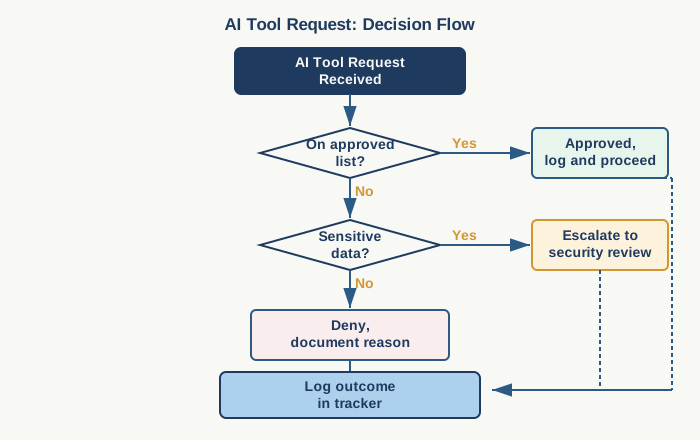
Connect this to your approval workflow. When a team proposes using a new AI tool, create a lightweight gate. Not bureaucratic. A 15-minute conversation: What data will it touch? Is that data type approved for external tools? Is the tool on your organization's agreement list? Does it need security review? If yes to any of those, escalate it before the work starts. If no, the team has your answer immediately. Most tools will clear this. Some will not. The ones that do not are the ones that would have created risk later.
One honest limitation: this framework requires team adoption. If you treat it as compliance theater instead of delivery practice, teams will shadow-adopt tools instead of reporting them. The difference is framing. You are not policing tool choice. You are making sure the team knows which data types are safe to process, which tools are safe to use, and what to do if they want to use something new. That is permission-granting, not permission-blocking.
The tools to implement this are simple. Use your existing tools: Confluence, Notion, Jira, whatever your team already lives in. Create a template for tool requests. Log them in a project tracking system so you can see patterns. If your organization uses a governance dashboard, route requests there. You do not need new software. You need visibility and a repeatable decision process.
Run this as a 30-day pilot on one program. Document every AI tool request that comes in. Track which ones cleared, which ones got escalated, which ones got denied and why. After 30 days, count how many tools you actually discovered that nobody told you about. That number will tell you how much of your governance was real and how much was theater. Then build from there.
Practical AI intelligence for project managers. Weekly, free. Get frameworks, tools, and decisions that help you stay ahead of AI adoption on your projects. No hype. No filler. Subscribe free →
Not sure which AI tools to trust on your projects? Download the free AI Tool Evaluation Checklist: 12 questions PMs ask before approving any AI tool for their team. Download free →