
Using AI to Catch Scope Creep Before It Derails Delivery
Scope creep does not announce itself. It arrives in a Slack message asking for "one small addition.

Scope creep does not announce itself. It arrives in a Slack message asking for "one small addition." It lives in a steering committee conversation where someone says "while we are here, can we also." It hides in a change request that sounds minor until you do the math on timeline impact. And by the time you see it clearly, you have already committed the resources.
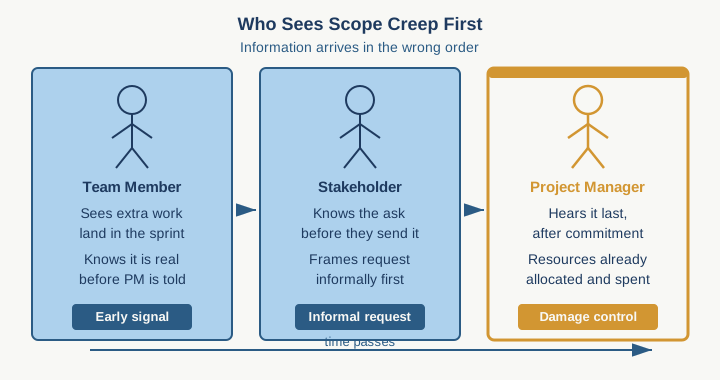
Most PMs know this pattern. What fewer PMs know is that they are usually the last person to notice scope creep happening. Your team sees it first. Your stakeholders see it coming. But it lands on your desk as a fait accompli, and then you are managing the damage instead of preventing it.
Here is what actually breaks in scope creep situations: not your ability to say no, but your ability to see the pattern before it becomes a problem. You are managing multiple communication channels, dozens of requests, and competing stakeholder pressures simultaneously. The request that adds five days of work does not feel like scope creep in isolation. It feels like responsiveness. Until you connect it to the three other "small" requests from last week, and suddenly your buffer is gone.
AI can help here, but not in the way most people think. It is not about an algorithm predicting the future. It is about giving you visibility into what is actually happening right now, across all the conversations and documents you are already creating.
Start with your change request process. Most teams have one. Most teams also admit it does not catch everything. A request comes in as an email, a Jira ticket, a Teams message, or mentioned casually in a meeting. Your job becomes detective work: Did this actually represent a change from scope? How much effort would it take? Should this have gone through formal approval?
An AI tool that reads change requests against your original project charter and scope statement can do that detective work at scale. Feed it your baseline requirements, your project objectives, and your approved deliverables. When a new request comes in, the AI asks a direct question: Does this align with the original scope, or does it expand it? How many days of effort? Which team member would handle it? What gets delayed if we approve this?
The tool is not making the decision. You are. But it is forcing the decision to exist in the first place. Right now, many scope changes happen because no one ever explicitly said "this is a change." AI makes that moment unavoidable.
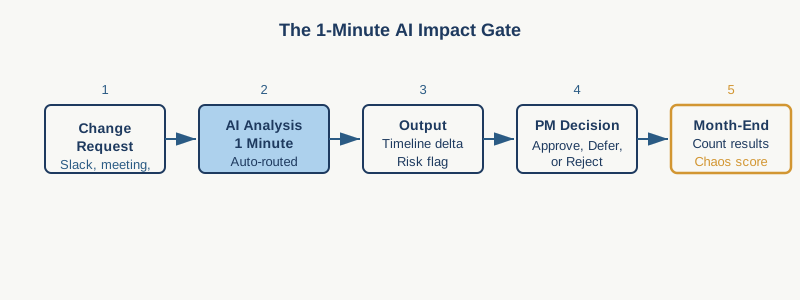
Here is the practical workflow: Set up your change request system to route through an AI analysis layer before it reaches your approval gate. When a request lands, the AI generates a one-page impact summary in less than a minute. It compares the request against your documented scope, flags which dependencies or milestones get affected, and estimates the resource impact. You then review that summary before deciding whether to approve, negotiate, or reject.
The limitation is real: AI cannot understand your political context. It cannot know that a request coming from the CFO matters differently than one from an individual contributor, even if the effort is identical. It cannot weigh strategic relationships the way you can. What it can do is make sure you see every request and its cost clearly before you agree to anything.
Start simple. If you are currently using Jira, Asana, or Smartsheet, check whether your platform has an AI layer that can analyze change requests. Microsoft Copilot in Jira and Asana AI both do this. Perplexity can also analyze change requests if you feed it your charter and the request as separate documents and ask it to identify scope alignment and effort impact.
The second place scope creep lives is in your status reporting and steering committee meetings. Stakeholders see feature requests, budget asks, and timeline pressures before they surface as formal changes. Your job in those meetings is to notice the pattern. "We have had four requests to expand testing. Let me loop back with the team on what that adds up to." That sentence prevents scope creep. But you have to see the pattern first.
Here is the move: Before your steering committee meeting, pull your recent change requests, emails about new requirements, and open Jira tickets mentioning new work. Ask an AI tool to summarize what categories of requests you are getting and what the cumulative effort would be if you approved all pending items. You now walk into the meeting with perspective. You can say, "We have capacity for two of the five requests we received this month. Here is my recommendation on which two and why." That is leadership. That is also scope defense.
The real test of this approach comes in week three or four. You will have prevented something that would have silently eaten ten days of your timeline. That moment matters. Not because the AI caught it, but because the system you built made it impossible to miss.
Run this for a month: Route all change requests through a one-minute AI impact analysis before you approve them. Do nothing else different. At the end of month one, count how many requests you approved, how many you deferred, and what your team says about whether the chaos decreased.
That number will tell you whether you actually have a scope problem or just a visibility problem.
Practical AI intelligence for project managers. Weekly, free. Get frameworks, tools, and decisions that help you stay ahead of AI adoption on your projects. No hype. No filler. Subscribe free →
Stop writing from scratch. Get the 20 prompts PMs actually use for status reports, stakeholder updates, and retro summaries. Download free →