Six Skills That Compound as AI Expands
The moment you automate your first meaningful workflow with AI, something shifts.
The moment you automate your first meaningful workflow with AI, something shifts. You are no longer managing in a world where AI is a tool you evaluate. You are managing in a world where AI is a tool your team uses every day, and the competitive advantage belongs to the person who knows which human skills matter more when machines handle the routine work.
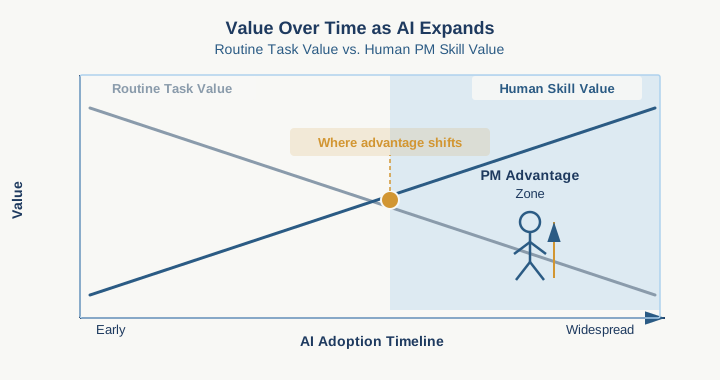
This is not about whether AI will change project management. It already is. This is about which PMs will lead confidently through that change and which will scramble to keep up.
Here is what I have observed: the PMs who are winning right now are not the ones with the most AI tools in their stack. They are the ones who developed a specific set of skills before AI arrived and have intentionally deepened those skills as AI capabilities expanded. Those skills compound. They make you more effective at delegation, risk management, stakeholder persuasion, and delivery health than you were six months ago. And they will make you even more valuable as AI gets smarter.
Let me name six of them.
Strategic judgment over task execution. This one matters most. As AI takes over routine tasks (drafting status reports, summarizing meeting notes, flagging schedule risks in Jira), your value increasingly depends on knowing which problems deserve AI assistance and which ones require your human judgment. A steering committee does not need AI to write their status report. They need you to look at the data, talk to the team, and decide whether the green status you are seeing is honest. They need you to recognize when a dependency is not actually a dependency, just an assumption someone repeated three times. That judgment is what they hired you for. The PMs who confuse "AI can automate this" with "I should automate this" will find themselves managing processes instead of outcomes.
Cross-functional translation. Your technical team speaks one language about what is possible with AI. Your finance stakeholders speak another. Your delivery team speaks a third. The PM who can move fluently between those conversations, translating constraints into possibilities and possibilities into reality, becomes the person who actually makes things work. This was always a competitive skill. It becomes essential when half your team is experimenting with new tools and the other half is asking why delivery feels different. You translate what happened into what it means.
Human-centered workflow design. The instinct is to automate everything you can. The discipline is to ask whether you should. A workflow that replaces human decision-making with machine speed might look more efficient on a spreadsheet and feel slower in the room. A workflow that uses AI to surface options, organize information, and eliminate drudgework, while keeping the human in the critical decisions, will feel faster to the people living it. Designing that distinction is a skill most PMs are still learning. The ones who get it early will have teams that trust the change.
Adaptive learning and iteration. Ten years ago, you could learn a tool and rely on it for years. Now a new capability appears, and you need to ask within weeks whether it changes how your team should work. This does not mean you adopt everything. It means you have a reliable process for testing, measuring, and deciding. You run a small experiment with a new tool. You measure whether it actually saved time or just moved the time somewhere else. You decide: keep it, modify it, or drop it. Then you do it again next month. The teams that normalize this pace of change will adapt faster than those waiting for perfect information.
Stakeholder communication that acknowledges uncertainty. When you have a strong sense of delivery health, you can communicate clearly. When AI introduces new variables to your process, you might feel less certain. The skill is saying that honestly. "We are using AI to surface risks faster, so we are catching three things earlier than we would have. Here is what we found and what we are doing about it. Our confidence in this milestone is higher because of the early signal." That is stronger than pretending the new tools made everything predictable.
Clarity about what success looks like. This one underlies all the others. Before you invest in any new tool or workflow, define what better actually means for your specific project. Not hypothetically. Not in buzzwords. Is it fewer surprises in steering committee meetings? Faster turnaround on status requests? Earlier visibility into resource constraints? Fewer nights spent building reports? Once you know what you are optimizing for, you can evaluate whether an AI tool moves that needle. Most PMs skip this step. That is why they try a dozen tools and feel like nothing stuck.
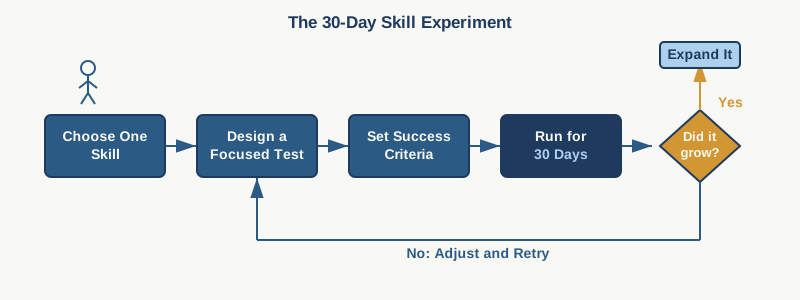
Start here: pick one of these six skills. Not all of them. One. Ask your team which one would have the biggest impact on how they experience their work over the next quarter. Then design a small experiment to strengthen it. If it is stakeholder communication, run your next steering meeting with a more honest frame about what the team is uncertain about. If it is adaptive learning, pick one new tool and commit to a three-week trial with clear success criteria. If it is human-centered design, audit one workflow and ask whether AI should optimize for speed or for human judgment.
The gap between managing projects in an AI-enabled world and managing projects that are designed for an AI-enabled world is not technical. It is skill. And skills compound. Run this experiment for thirty days and notice what else changes.
Practical AI intelligence for project managers. Weekly, free. Get frameworks, tools, and decisions that help you stay ahead of AI adoption on your projects. No hype. No filler. Subscribe free →
Stop writing from scratch. Get the 20 prompts PMs actually use for status reports, stakeholder updates, and retro summaries. Download free →