Before You Approve AI Work on Your Project, Run This Governance Check
If you manage projects in a regulated industry, someone just made a decision that affects which tools will…

If you manage projects in a regulated industry, someone just made a decision that affects which tools will actually work for your team in three years.
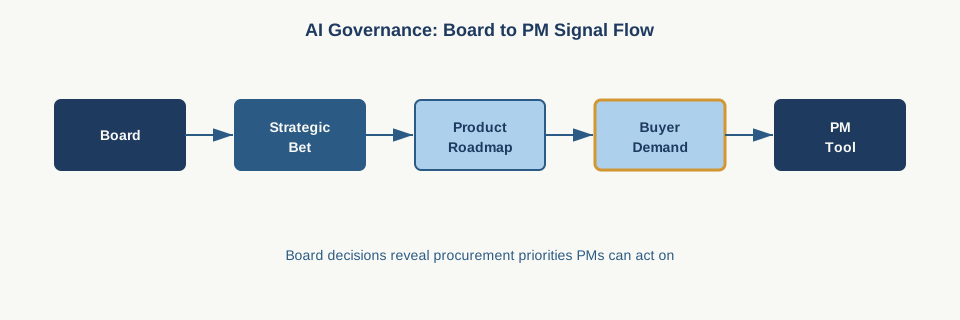
Anthropic appointed a healthcare industry veteran to its board last month. That is not a routine governance move. Board seats signal long-term strategic bets. And in this case, it signals that Anthropic is building AI specifically designed for environments where you cannot afford hallucinations, where audit trails matter more than speed, and where compliance is not a checkbox but a delivery requirement.
Here is what this means for you as a PM: the enterprise AI tools you evaluate today will increasingly be shaped by what healthcare buyers demand. Healthcare is the canary in the coal mine for regulated industries. If you work in biotech, pharmaceutical delivery, medtech, financial services, or any sector where regulators are watching, the products being built for healthcare PMs right now are coming to your industry next.
The problem most PMs face when adopting AI tools is not that AI hallucinations happen. It is that you cannot prove they did not happen. You file a status report. You generate a risk summary. You share a compliance checklist. Three months later, an auditor or a stakeholder asks for the source. And if the AI invented or conflated something, you have no trail back to ground truth. In a general business workflow, that is embarrassing. In healthcare, that is a compliance incident.
This is where Anthropic's reputation matters. The company has built its entire brand on AI safety and interpretability. That means when you use Claude to help manage a project, the AI is designed to be careful about what it claims to know versus what it is inferring. It pushes back on requests it is uncertain about. It explains its reasoning. These are not features that sell to startups. They sell to hospitals, insurers, and regulated delivery teams.
For a healthcare PM managing a clinical trial or a new hospital system implementation, this changes which tools they can use and how they can use them. You cannot ask a generic AI assistant to summarize HIPAA-relevant decisions because you have no way to verify it caught the right things. You cannot auto-generate compliance documentation if you cannot trace every statement back to source policy. But if the underlying AI is built with that accountability baked in, the tool becomes useful instead of a liability.
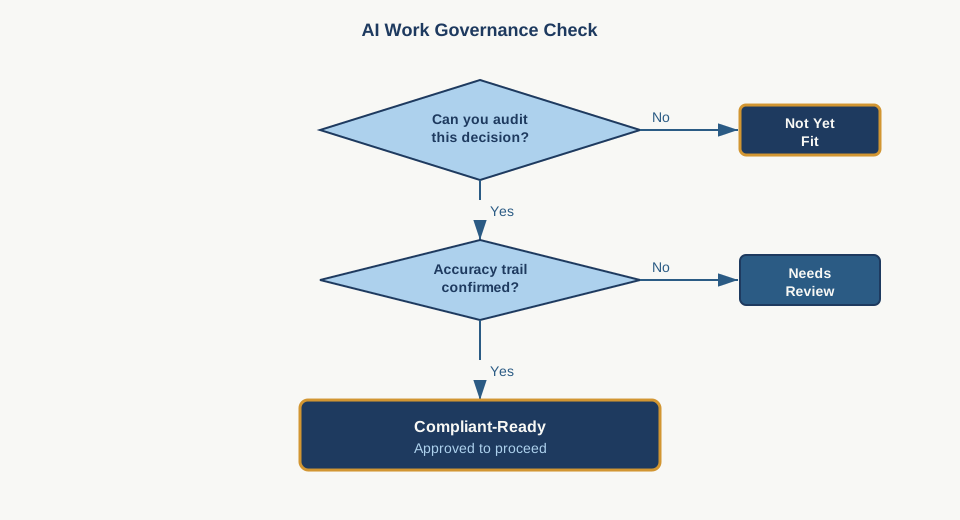
The practical implication for you is simple: when you are evaluating project management tools or AI assistants over the next year, start asking about auditability and explainability. Not as nice-to-haves. As core requirements. Ask: Can I see why this recommendation was made? Can I export the reasoning? Can I prove what happened and when? Tools built with healthcare compliance in mind will have answers to these questions. Tools built for general business will not.
This matters even if you do not work in healthcare. Regulators are moving toward requiring explainability in AI-assisted decisions across most industries. The companies that learned to build it for healthcare first will have a three-year advantage when your industry faces the same requirements.
If you are managing a major implementation or a complex multi-department project right now, there is a 30-day test you can run. Take one recurring task where you currently use AI casually, like generating a weekly status summary or flagging risks. Run it through a tool built with explainability in mind. Claude is one option. Gemini Advanced is another depending on your Google stack. For each output, ask yourself: Could I defend this decision in front of a steering committee? Could I trace where each statement came from? If the answer is yes, you have found a workflow worth systematizing. If the answer is no, you know the tool is not yet mature enough for your delivery critical work.
The board appointment means healthcare-first AI is no longer a niche play. It is becoming table stakes for enterprise vendors. The tools you use for project management will start reflecting those standards. That is good news. It means the AI tools you trust with your delivery will be built by companies thinking about compliance, accuracy, and auditability from day one, not bolting them on later as an afterthought.
Count how many decisions you made last month that you could not fully justify if asked. That is the real measure of whether your current PM tooling is ready for the era of explainable AI. Start there.
Practical AI intelligence for project managers. Weekly, free. Get frameworks, tools, and decisions that help you stay ahead of AI adoption on your projects. No hype. No filler. Subscribe free →
Not sure which AI tools to trust on your projects? Download the free AI Tool Evaluation Checklist: 12 questions PMs ask before approving any AI tool for their team. Download free →