AI Risk Check Every Project Manager Needs Before Launch
I've sat through the kickoff meeting for an AI project where everyone nodded. The architecture looked solid.

I've sat through the kickoff meeting for an AI project where everyone nodded. The architecture looked solid. The timeline looked reasonable. Six months later, it was a disaster, and nobody could name exactly when the plan stopped working.
The parallel to Everest is not metaphorical. When you deploy a high-risk AI system, you are managing the same class of problem that kills climbers: the gap between what you prepared for and what actually happens once you commit to the slope. On a mountain, that gap is weather and altitude. In AI projects, it is model behavior in production, data drift, integration friction, and the thousand small failures that only show up under real load. Both demand a specific kind of project discipline that most teams simply do not practice.
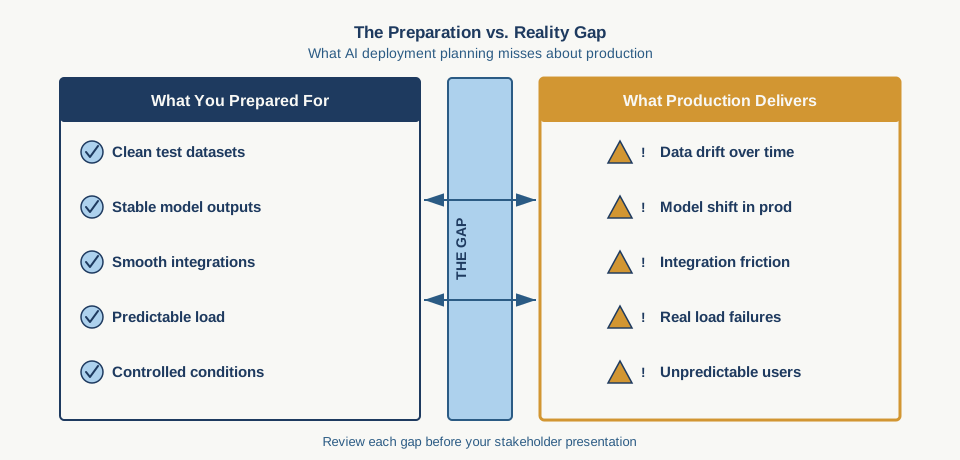
Here is what breaks most high-risk AI deployments: the team plans the launch as if it is binary. You build, you test, you release, you are done. In reality, the project does not end at launch. It transforms. The work shifts from development to maintenance, from building the system to keeping it from degrading. Most teams are not structured for that handoff, and most stakeholders do not understand that it is coming. By the time model performance starts sliding or the integration with your actual workflow reveals unforeseen friction, you have already committed budget, credibility, and team capacity to something that looks like it is failing but is actually just entering its hardest phase.
The Everest framework reframes this. Climbers do not treat summiting as the mission. They treat reaching the summit and descending alive as the mission. That changes every decision upstream. It means you establish base camps not to reach them faster but to make failure safer. You station resources at each camp not because you need them there continuously but because you might need to retreat. You plan the descent route before you ever leave base camp because you will not have clarity to plan it at 28,000 feet.
For a project manager, this translates into one essential practice: design your escape routes before you flip the switch.
What does that mean concretely? Start with staged rollout architecture. Use an AI governance checklist for project managers to confirm your risk management structure is ready for AI-specific failure modes before you commit. Do not deploy your AI system to 100 percent of users on day one. Deploy to 10 percent, measure performance, watch for drift, listen to user friction. Most teams already know this intellectually. Few actually resource it. You need dedicated capacity to monitor those early cohorts, not monitoring as an afterthought but as the primary work. Build this into your timeline and your team structure from the charter forward.
Next, establish continuous surveillance of model behavior. A structured AI project risk assessment checklist helps you evaluate each of these dimensions systematically before your project commits to a deployment model. Everest climbers check weather every two hours. They check altitude every hour. They check each climber's condition constantly. Your AI system needs the same cadence. What metrics matter depends on what your system does, but at minimum you need to track model accuracy in production, data quality of inputs, system latency, and user behavior changes. When one of these starts to move, you need to know within hours, not days. This requires real-time monitoring infrastructure and a clear escalation path to your steering committee. If you cannot explain to your sponsor what "model drift" means and why it matters to the delivery timeline, you are not ready to go live.
Third, prepare for the moment when conditions demand retreat. In climbing, that moment is often when you are furthest from safety. In AI projects, it is when the system is already live and performing worse than the alternative you replaced. Build a rollback procedure now. What does it take to turn this off? How long does it take? What is the cost? What is the communication plan? If you cannot answer these questions in your project plan, add them before you proceed. The worst time to design a kill switch is when you need to use it.
The fourth lesson is about Sherpa culture. On Everest, the Sherpas are not just porters. They are the continuous intelligence layer. They watch conditions constantly. They know what is normal and what is not. They flag problems before they become catastrophic. Your monitoring team serves the same function. Make them part of your governance, not consultants to it. Give them voice in steering committee meetings. Create a rhythm where they report on system health and model behavior, the same way your project manager reports on schedule and scope.
Here is the tool pattern that matters: you need one unified monitoring dashboard that combines real-time model performance, system health, user feedback signals, and escalation triggers. DataDog, New Relic, or Weights and Biases can each provide pieces. The mistake is treating them as separate. Build a simple Confluence page or Notion database that pulls signals from all of them and updates weekly for your steering committee. One page. Clear RAG status. One escalation threshold that triggers a decision meeting about rollback.
The practical move this week: map out your project's base camps. For a typical AI deployment, you might have four: proof of concept, limited beta, staged production launch, and full production. For each camp, define what success looks like and what conditions force retreat. Then define the cost and timeline of retreat at each stage. This becomes your risk register. Share it with your steering committee. If they push back on the retreat scenarios, that tells you the project is not yet ready to proceed.
Run this analysis before you commit to launch. The best time to build an escape route is before you need it.
Practical AI intelligence for project managers. Weekly, free. Get frameworks, tools, and decisions that help you stay ahead of AI adoption on your projects. No hype. No filler. Subscribe free →
Stop writing from scratch. Get the 20 prompts PMs actually use for status reports, stakeholder updates, and retro summaries. Download free →