How to Close the AI Adoption Gap Before Your ROI Disappears
You rolled out a new AI tool to your team three months ago. Everyone attended the training.

You rolled out a new AI tool to your team three months ago. Everyone attended the training. The tool works. And almost nobody uses it the way you intended.
This is not a failure of the tool. This is a failure of adoption, and it is quietly destroying your ROI before you even know you had one.
Most organizations treat AI adoption as a technology problem. You buy the tool, train people on it, and expect velocity to follow. What actually happens is different. Your PMs keep using their old workflows because they trust them. The tool sits half-integrated into your process, creating two parallel ways of working instead of replacing one. You lose the efficiency gain you paid for, and you lose it silently, which makes it worse.
Here is what is actually happening: your team is not lazy or resistant. They are uncertain. They do not trust the output yet. They are not confident they know when to use the tool versus when to do it manually. And nobody has clearly shown them that using it actually makes their job easier, not just different. That gap between adoption and the skill or confidence to adopt it is where your transformation dollars go to disappear.
The mechanism is straightforward. When a PM doubts an AI workflow, they do the work twice: once manually to be safe, once through the tool to comply with the new standard. That is doubled effort, not efficiency. They become more tired, not more productive. So they stop using the tool. Months later, you notice adoption metrics are low and assume people need more training. You do not realize the problem was not understanding. It was trust built through real, low-risk experience.
This matters for your delivery because adoption failures directly impact your ability to scale. If your status reporting still runs through manual consolidation because nobody trusts AI to surface the real risks, you cannot accelerate that process. If your RAID log flagging still depends on someone remembering to check it because the AI-assisted prompts feel like extra work, you have not actually freed anyone up. You have just added a new step that nobody wants.
The pattern I see work is simple: pair every new AI tool with a structured adoption project that has an owner, a timeline, and a feedback loop. Not a one-time training. Not a "figure it out" approach. A project.
Start with your early adopters. Pick two or three PMs who are naturally curious and give them real problems to solve with the tool. Do not ask them to learn it generically. Ask them to use it to do something they already do, but better. If you are rolling out AI for status report generation, have them generate their next three reports with it while you sit in and ask what broke, what felt faster, what felt slower. Document exactly what worked. That is your proof point.
Then bring the next group in, not with training slides, but with the workflow your adopters actually use. Show them the specific prompts. Show them the output. Let them see where a peer had to edit or adjust the AI result. This builds realistic confidence, not false confidence.
As adoption widens, track adoption depth, not just adoption rate. Know the difference: adoption rate is how many people logged in. Adoption depth is how many people integrated the tool into their actual delivery workflow. You want the second metric. A PM who uses AI for one email a month is not adopted. A PM who uses it to draft status reports, summarize meeting notes, and flag risks is adopted.
Watch for the three patterns that kill adoption silently. First: people trust the tool on small, low-stakes tasks but not on high-stakes decisions. That is normal. Do not override it. Instead, guide them toward the tool for what it is genuinely good at, and do not oversell it. Second: people have a faster manual workaround for their specific situation, so the tool feels slower. Ask them why. Sometimes they are right, and your workflow needs redesign. Third: people do not understand why the tool exists. They see it as software they were told to use, not a solution to a real problem they face. Reframe it around their problem, not the tool.
Your next move: identify one AI tool you have rolled out that adoption rates are below 60 percent. Do not roll out another tool until you understand why. Talk to five PMs who do not use it regularly. Ask them directly: "What would have to be true for you to use this in your standard workflow?" Listen for the gap between the tool capability and their specific confidence or need. Then design a four-week adoption sprint to close it, not a training sprint.
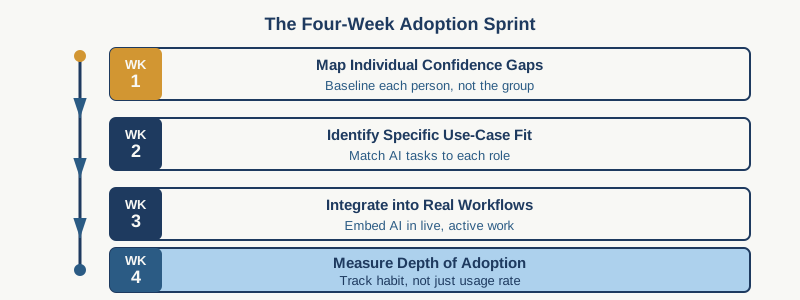
Run that experiment and watch what shifts. You will find the adoption gap is not about intelligence or resistance. It is about clarity, trust, and fitting the tool into the real shape of how you work. Close that gap and your ROI stops disappearing.
Practical AI intelligence for project managers. Weekly, free. Get frameworks, tools, and decisions that help you stay ahead of AI adoption on your projects. No hype. No filler. Subscribe free →
Stop writing from scratch. Get the 20 prompts PMs actually use for status reports, stakeholder updates, and retro summaries. Download free →