Why AI Status Reports Still Need a PM's Judgment
Most project managers spend three to five hours a week on status reports.

Most project managers spend three to five hours a week on status reports, not just writing them. I mean the full cycle: pulling data from a dozen sources, wrestling it into narrative shape, checking tone and completeness, getting feedback, revising, and sending. That is time you are not spending on the actual work of unblocking your team or managing risk.
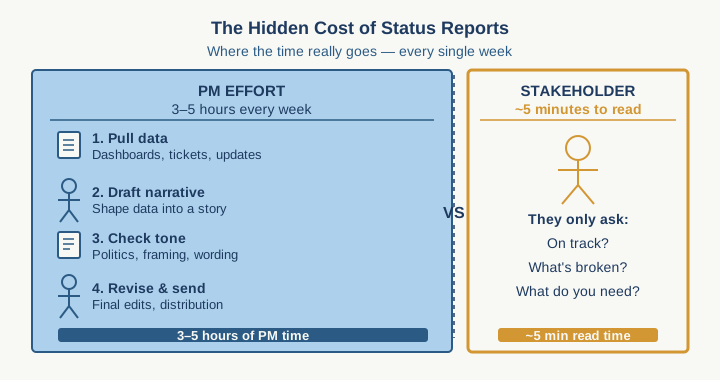
Here is what makes this worse: the time you spend is not proportional to the value delivered. A steering committee reads a status report for five minutes. They want to know: Are we on track? What is broken? What do you need from us? Everything else is noise. Yet you spend hours trying to sound comprehensive enough that no one can accuse you of missing something. AI can collapse that entire loop without sacrificing the signal.
The real problem is not that you write slowly. It is that you carry too many contexts in your head at once. You are mentally translating between the detail your team cares about (what is blocking us, why did we miss the date, what is our next move) and the language your sponsors need (strategic alignment, budget impact, delivery risk to the business). You are also fighting the blank page, the moment where you have to decide whether to lead with the schedule slip or the resource constraint or the new dependency that emerged last week. That moment costs you an hour just deciding what the story is.
AI cannot decide your story for you. But it can eliminate the translation and the blank page problem in a way that cuts your time by half and actually makes your reports clearer.
Here is the workflow that works:
Start with raw material, not a blank screen. Before you open your AI tool, spend five minutes dumping what matters into a simple list: schedule status (on track / at risk / slipped), why (if not on track), top three risks, one blocker needing escalation, resource news, milestone dates coming up. That is it. These are notes, not prose. Messy is fine.
Use AI to translate, not to hallucinate. Paste your raw notes into a prompt like this: "I am a project manager. Here are my project notes for this week. Generate a status report narrative that leads with schedule status, explains the why in one sentence, surfaces risks, and names what I need from leadership. Keep it to four paragraphs. Tone: direct, no fluff." AI will take your scattered notes and produce something that reads like a report. Not a final report, yet. But something with shape and logic already in place.
Customize for your audience in a second pass. If this report is going to a steering committee full of CFOs, add a second prompt: "Rewrite the above focusing on budget impact and resource implications. Remove technical detail. Keep executive tone." If it is going to your team, use a different prompt: "Rewrite the above to be clear about what is blocking us and what we need to unblock." You now have two versions tailored to two audiences in minutes instead of hours.
Edit what you have, not what you imagine. With the AI draft in front of you, your job is simple: does this say what actually happened? Is the tone right for this audience? Are the dates accurate? Is there anything that is just wrong? You are editing real prose, not generating it from nothing. This takes 10 to 15 minutes for most people.
The honest limitation: AI will sometimes overstate certainty. A risk that is "possible" might come through as "likely." Dates that are assumptions might sound like facts. You have to read with a skeptical eye and correct the record. This is why you cannot set and forget. But you are not doing heavy lifting anymore. You are quality-checking something that already has the right structure and shape.
What changes is not just time. It is confidence. When you separate the data gathering (what did we actually do?) from the narrative work (how do I tell this story?), you stop second-guessing yourself. You have a record. You have a framework. The report becomes something you deliver, not something you agonize over.
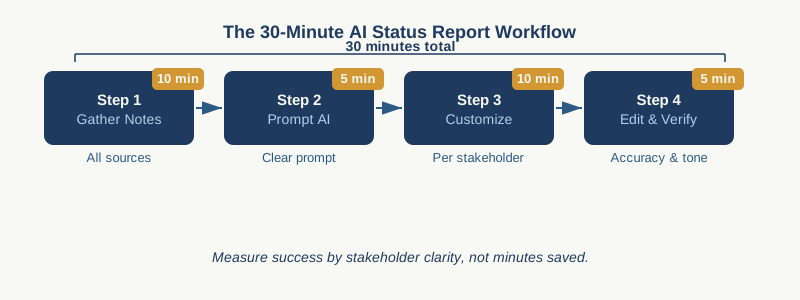
Try this on your next status report cycle. Instead of blocking two hours on your calendar, block 30 minutes: 10 minutes to gather notes, 5 minutes to feed them to AI with a clear prompt, 10 minutes to customize for stakeholders, 5 minutes to edit for accuracy. Track how much time you actually spend. Then count how many stakeholders actually say they found the report clearer. That number matters more than the time saved. If your sponsors understand the project health faster, you have won.
Practical AI intelligence for project managers. Weekly, free. Get frameworks, tools, and decisions that help you stay ahead of AI adoption on your projects. No hype. No filler. Subscribe free →
Stop writing from scratch. Get the 20 prompts PMs actually use for status reports, stakeholder updates, and retro summaries. Download free →