Why You're Spending Time on the Wrong Stakeholders
You know the moment. You're in a steering committee meeting, and a stakeholder who has barely spoken the…

You know the moment. You're in a steering committee meeting, and a stakeholder who has barely spoken the entire project suddenly demands a change. Your team looks at you. The budget holder shifts in their seat. And you realize: you never mapped who actually mattered on this project, or why.
Stakeholder management is where most project plans fall apart. Not because you didn't try. But because you treated all stakeholders as equally important, when in reality, three of them control everything and two others are just along for the ride. The Stakeholder Salience Model fixes this. It gives you a framework to answer the question every PM should ask before day one: Who decides what, and what do I owe them?
The model works on three dimensions. Power: who can actually stop or accelerate the project. Legitimacy: who has the right to have a say based on their role or stake in the outcome. Urgency: how much they care about being heard right now. These three dimensions aren't abstract. They determine who gets weekly updates, who gets monthly recaps, who gets copied on decisions, and who you escalate to when things go sideways.
Here's what breaks down in real delivery: you treat urgency and power as the same thing. A loudly demanding stakeholder feels important. So you spend energy managing them. But if they have no actual power (if your sponsor can overrule them in five minutes), you've just burned cycles on the wrong person. The salience model forces you to separate the noise from the signal. That distinction is worth money.
Mapping the three dimensions
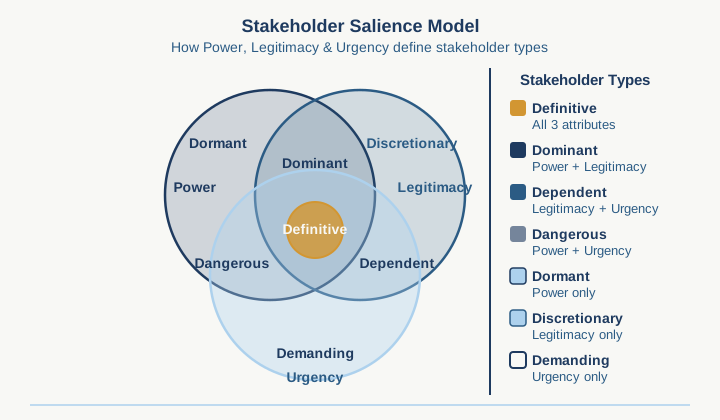
Power is straightforward but often misread. Who controls budget, scope, timeline, or resource allocation? That's power. So is the ability to kill the project or escalate above you. In a typical project, this might be your sponsor, the steering committee chair, and the finance business partner. Three people. Everyone else has less.
Legitimacy is broader. Yes, the sponsor has legitimacy. So does the end user who will live with the outcome. So does the compliance officer if your industry is regulated. Legitimacy is not power; it's the right to have input. A VP of operations might have less budget power than a CFO, but legitimacy matters more because the team reports to them daily.
Urgency is where people get it wrong. High urgency does not mean someone is important. It means they need something from the project right now. A stakeholder pushing for an early beta because their business launch depends on it? High urgency. A team member who wants weekly status calls because they like structure? Lower urgency. Don't confuse preference with need.
Once you've rated each stakeholder on these three dimensions, you get four tiers. Definitive players have high power and legitimacy: your sponsor, your steering committee, your delivery lead. These people get your real-time attention. Every decision, every risk, escalates to them. Dependent actors have legitimacy and urgency but less power: end users, affected teams, compliance partners. You need their input, but through structured channels. Dominant actors have power but lower legitimacy: executives who care about the result but not the process. They get regular updates, not constant dialogue. Dormant forces have low marks across all three. They matter only if urgency or power shifts.
The moment you map your project this way, your stakeholder engagement strategy changes. You stop trying to keep everyone equally informed. You stop responding to every urgent request with the same energy. You prioritize ruthlessly based on actual influence.
Where AI accelerates this
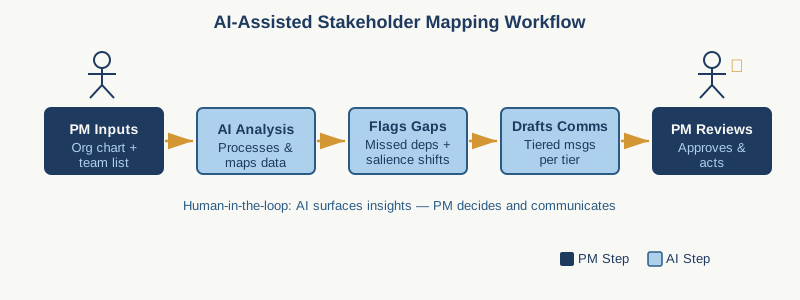
Here's what AI can do: help you spot the pattern faster and flag when something changes. You can feed AI your project structure: your team list, your org chart, your steering committee membership, and ask it to surface stakeholder dependencies you missed. More useful: you can prompt it to draft tiered communication templates. A different cadence and detail level for definitive players versus dependent actors. Same information, different framing.
The harder part is not the mapping. It's catching when a stakeholder's salience shifts. A new executive joins. A budget crisis makes finance suddenly dominant. An end user delay means operations urgency spikes. You need a way to flag this without checking in every week on every stakeholder.
This is where a simple tracked template, like a living spreadsheet or Notion table with your stakeholder matrix, becomes your early-warning system. Add a column for "last reassessment date." Every four weeks, spend 20 minutes with your delivery lead asking: did anything change? Did we promote anyone? Did anyone's urgency shift? Did power consolidate? Use an AI prompt to help you rewrite engagement plans when the tier changes. The tool is not the point. The check-in discipline is.
The test
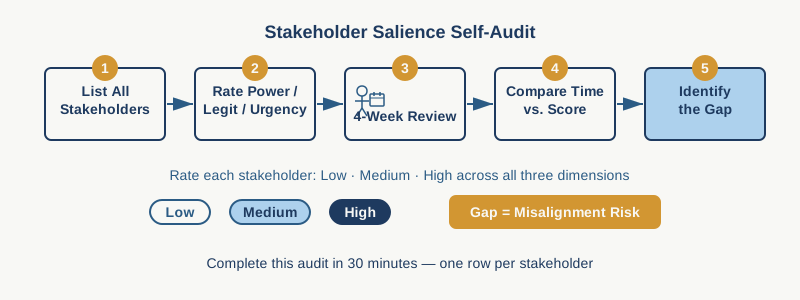
Pick your current project. Spend 30 minutes mapping your stakeholders across power, legitimacy, and urgency. Do not overthink it. Rate each one low, medium, or high. Then look at your last four weeks of calendar and email. How much time did you spend on definitive players versus dormant forces? You'll probably find you spent way too much energy on the wrong people.
That gap is your answer.
Practical AI intelligence for project managers. Weekly, free. Get frameworks, tools, and decisions that help you stay ahead of AI adoption on your projects. No hype. No filler. Subscribe free →