
The Daily Standup Is Not a Status Meeting
Most teams have a status meeting and call it a standup. Here is what a daily coordination ceremony is actually supposed to do -- and three formats that make it work.

The daily standup was designed to solve a specific problem: in software delivery, the main source of delay is not technical complexity. It is invisible dependency -- work that cannot progress because someone is waiting on something they have not named yet.
As more teams automate status capture with AI-assisted tools, the value of the daily standup shifts further toward coordination, judgment, and fast intervention — the signals that automation cannot surface on its own.
The 15-minute format exists to create a daily inspection point where those invisible dependencies become visible before they become blockers.
When it works, it is one of the most efficient ceremonies in Agile delivery. When it becomes a status meeting, it becomes one of the most expensive: a daily interruption that generates no useful signal and consumes time and attention that would be better spent on the work.
Most teams have a status meeting and call it a standup.
What a Status Meeting Looks Like
You can identify a status meeting by its answers. Listen for:
"Yesterday I worked on the API integration. Today I am continuing that. No blockers."
This sentence contains no useful information for the team. "Working on" and "continuing" describe activity, not state. The team cannot coordinate based on this. They know only that the person was busy yesterday and will be busy today.
The three-question format (yesterday / today / blockers) was designed to surface coordination needs. When teams interpret "blockers" as "things currently preventing me from working," they miss the actual intent: "things that could prevent us from meeting our sprint goal if they are not addressed."
The difference is the word "currently." A blocker that is currently active has already become a problem. The ceremony is designed to surface future blockers before they activate.
Download: Agile Delivery Health Checklist
12 signals that tell you if your team is actually delivering — not just running ceremonies. Free.
What It Should Be Instead
The daily standup is a sprint execution check, not a personal report. The question the team is trying to answer is: "Are we on track to meet our sprint goal, and if not, what needs to happen today?"
That question can be answered in several ways that work better than the three-question format:
Walk the board
The team walks through the sprint board from right to left -- from "done" toward "in progress" toward "to do." The conversation is about work items, not people.
Items in progress get one question: "What does this need to move right?" That answer either reveals a blocker (escalate), a dependency (coordinate), or nothing (move on).
This format surfaces coordination needs faster than the personal report format because the artifact -- the board -- does not have the social dynamics that individual reports do. Nobody needs to admit they are stuck. The item is stuck.
Use a simple status indicator
Instead of open-ended reporting, each team member categorizes their work with three signals:
- On track
- Needs attention (explain)
- Blocked (name what is blocking)
This keeps the ceremony to its minimum viable purpose: identify items that need the team's attention. Items flagged as "needs attention" or "blocked" get discussion. Everything else gets acknowledged and moved on.
Ask the goal question directly
Start the standup with: "Is there anything that would prevent us from meeting our sprint goal?" Then stay quiet. Teams that have built genuine psychological safety will name things. Teams that are performing will not, and that gap is information too.
The Async Standup and When It Works
Distributed and hybrid teams often run asynchronous standups: each person posts a written update in a shared channel, the team reviews it before the scheduled standup, and the synchronous time is reserved only for items that need live conversation.
This model works well when:
- The team spans multiple time zones and synchronous overlap is limited
- Written communication is already the team's primary working mode
- The synchronous standup has become a performance rather than a coordination exercise
It breaks down when written updates become as formulaic as the spoken ones. The same "worked on X, continuing X, no blockers" pattern produces no more signal in writing than in person.
Async format or not, the quality of a standup depends on whether the team has learned to name real coordination needs. The ceremony mechanics help, but they do not substitute for the underlying behavior.
What the Scrum Master Owns
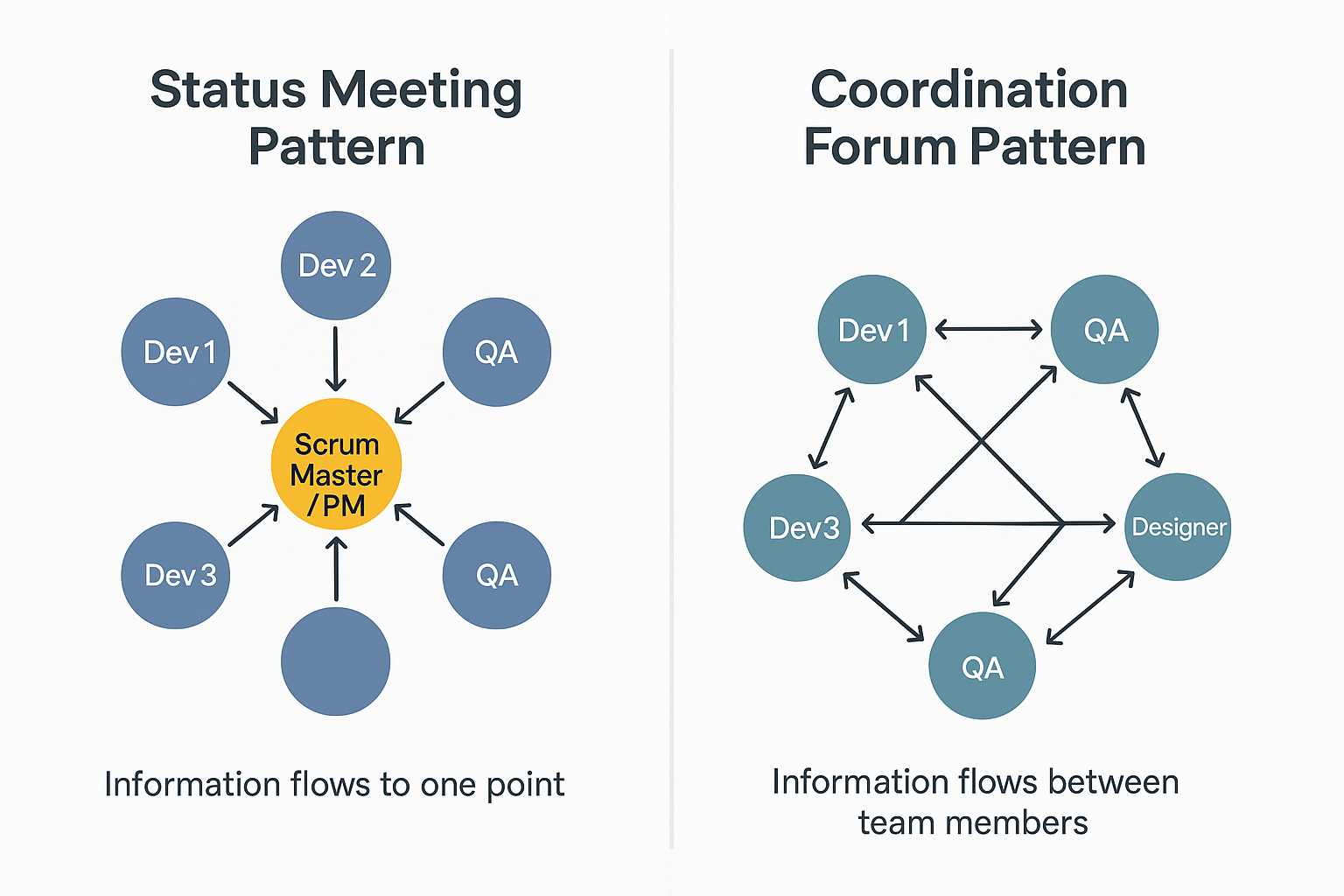
The most common facilitation mistake is letting the standup drift into a series of bilateral conversations between team members and the Scrum Master. The SM asks a question, the developer answers, the SM nods. Everyone else watches.
This is a manager pattern, not a coordination pattern. The daily standup should be addressed to the team, not the SM.
Practically: position yourself at the edge or back of the room (or mute your video in a remote standup). Make eye contact with the board or the team, not each individual speaker. When someone says something that another team member needs to hear, gesture toward that person. "Tell the team, not me."
It takes three to five standups to break a status-report habit that has been running for months. That is normal. Do not give up on it after one awkward session.
When a Standup Is Going Wrong
Signs the ceremony has become a status meeting:
- The same blockers appear in the standup for multiple consecutive days without resolution
- Team members ask follow-up questions after the ceremony rather than during it
- The standup runs long because people are sharing context that the team should already have
- Nobody addresses each other -- all answers go through the SM or tech lead
- "No blockers" is said by every person on every day
If you are seeing three or more of these patterns, the ceremony needs to be reset. Not with a lecture about what standups are for, but by changing the format and observing what changes.
Agile Pulse goes out weekly -- practical guidance for Scrum Masters and delivery leads. Subscribe at indigo.pub to get it in your inbox.
Stay Current with Agile Pulse
Practical delivery intelligence for practitioners who want better sprints, better retros, and better standups. Weekly. Free.