
Sprint Planning Without Estimation Theater
For most teams, estimation is not a planning activity -- it is a ritual. Here is how to plan sprints that produce real commitments instead of managed numbers.

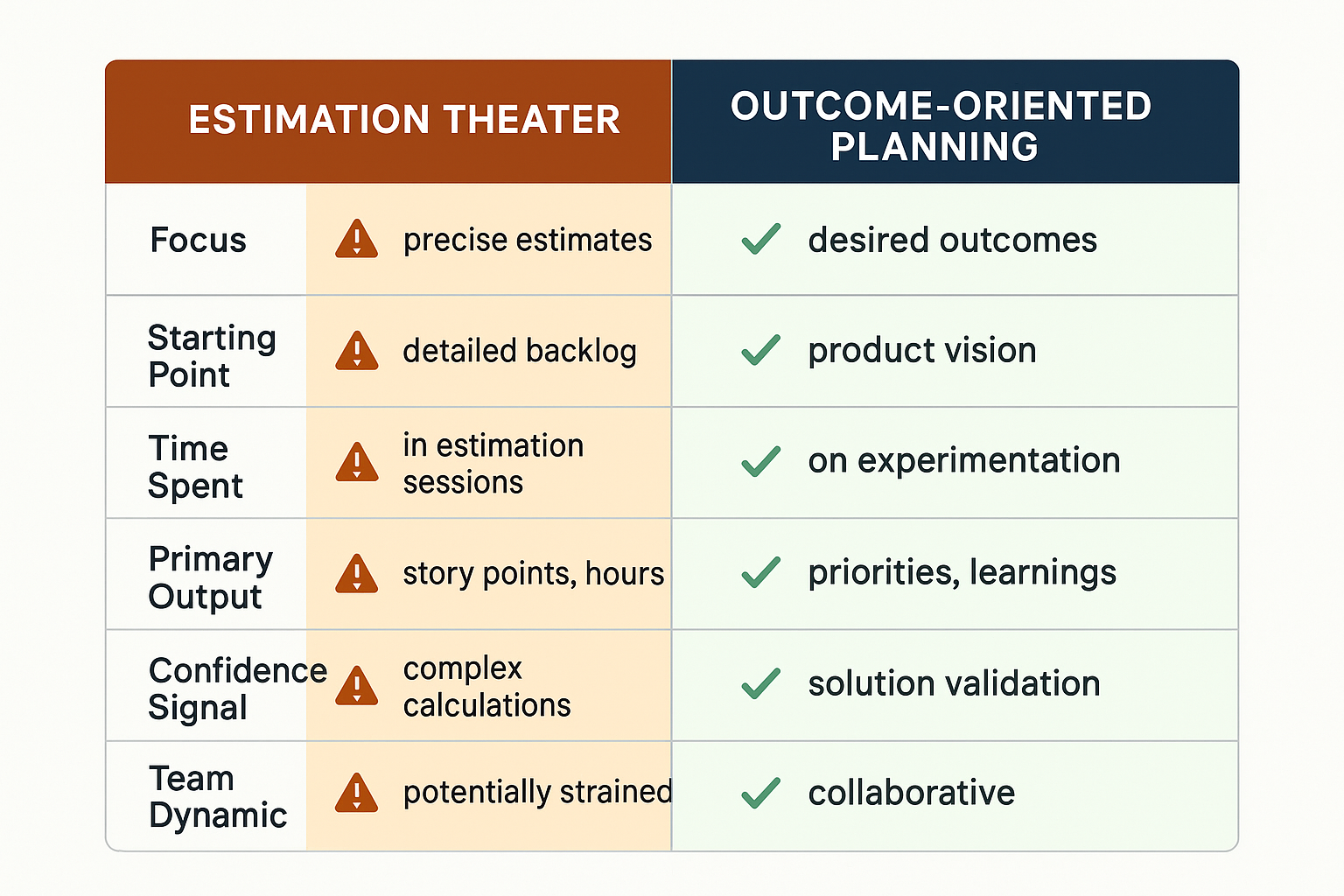
Sprint planning has a dirty secret: for most teams, estimation is not a planning activity. It is a ritual. Points go on cards, velocity gets cited, a sprint gets committed to -- and then the same conversations happen mid-sprint that would have happened without any of it.
AI tools are beginning to automate some of the estimation overhead — ticket scoring, complexity tagging, historical velocity analysis — which makes the ritual dimension of estimation even more visible.
This is not a Scrum problem. It is what happens when teams optimize for the look of planning rather than the substance of it. The team goes through the motions, management gets the confidence they need, and everyone moves on until the sprint starts falling apart.
If this describes your planning sessions, the good news is that the fix is not a new estimation technique. The fix is asking different questions.
What Planning Is Actually For
Sprint planning answers two questions:
- What can we commit to this sprint?
- How will we do it?
Most planning sessions spend 80% of the time on the first question and almost none on the second. This is backwards. The commitment question (velocity, capacity, points) feels important but is largely a fiction for teams at normal maturity. The how question is where actual risk lives.
If the team can describe in concrete terms how a piece of work will be done, the sprint commitment tends to be reasonable. If they cannot, no amount of pointing will make it more reliable.
The Theater Pattern
You can identify estimation theater by its symptoms:
Anchor bias in pointing. One person names a number, others follow. The discussion is about that number rather than about the work.
The same items take the same amount of time regardless of points. A one-pointer and a five-pointer both take three days because the point values were never calibrated to reality.
Velocity is managed, not measured. The team adjusts what it commits to in order to hit velocity targets, rather than committing to real work and measuring actual throughput.
Stories are groomed for pointability, not clarity. "This is too big to estimate" leads to decomposition that serves pointing, not delivery.
None of this is dishonest. It is the natural adaptation of teams who have learned that hitting velocity targets matters to their stakeholders, and who have reverse-engineered the process to produce the required outputs.
What to Do Instead
Replace estimation with conversation
For each story in the sprint, ask three questions:
- Can someone on the team describe concretely how this will be done?
- Are there dependencies that need to be confirmed before we start?
- What would cause this not to ship?
If the team can answer all three in under two minutes, the story is ready. If they cannot, the story is not ready -- regardless of what points are on it.
Use relative sizing only for backlog ordering
Story points have genuine value for one thing: helping a Product Owner prioritize a backlog. Large vs small vs unknown is useful signal for sequencing. But using points to commit to sprint scope is where the theater begins.
Keep points for backlog. Use conversation for commitment.
Reduce sprint commitment to sustainable pace
Teams consistently over-commit in planning. The social pressure to look capable in front of stakeholders is real. One structural fix: reduce your sprint commitment to 80% of the team's demonstrated throughput (not theoretical velocity) for two sprints, and measure what actually ships.
The number is usually not what anyone expected.
Name the work, not the size
Instead of "8 points," say "This will take Priya and Marcus about two days and requires a confirmed API contract from the platform team by Tuesday." That is a plan. Eight points is a guess dressed as a number.
When Estimation Still Makes Sense
Some contexts make estimation genuinely useful rather than ceremonial:
- When a team is genuinely learning a new domain and needs a shared calibration mechanism
- When relative sizing is being used to compare effort across initiatives (not to commit sprints)
- When a stakeholder needs rough order of magnitude for a decision, not a sprint commitment
In these contexts, lightweight methods -- T-shirt sizing, bucket estimation, three-point ranges -- are appropriate. What they should never be is a sprint commitment mechanism for a mature team that already knows its throughput.
A Better Planning Session
The most effective sprint planning sessions I have seen follow a simple pattern:
- Thirty minutes maximum on commitment (what are we taking in; does it fit our capacity?)
- Sixty minutes minimum on execution (how will we do each of these; what might go wrong?)
- Any story where "how" cannot be described in the session moves back to the backlog
The teams that do this report faster standups, fewer mid-sprint surprises, and -- ironically -- more accurate commitments. Not because they estimated better, but because they planned better.
One More Thing
Stakeholders need confidence. That is legitimate. The mistake is believing that estimation theater provides it. Stakeholders who see a team commit to the same velocity every sprint and hit it consistently are not getting accurate forecasts -- they are getting managed numbers.
The alternative is harder to sell initially and more valuable once established: show stakeholders throughput data over time, identify real risks early, and give them a clearer picture of what is actually going to ship. That is a more honest conversation. It is also the kind of conversation that builds real trust.
Agile Pulse goes out weekly -- practical guidance for Scrum Masters and delivery leads. Subscribe at indigo.pub to get it in your inbox.
Stay Current with Agile Pulse
Practical delivery intelligence for practitioners who want better sprints, better retros, and better standups. Weekly. Free.