
The Retrospective Formats That Actually Surface Team Blockers
Most retro formats feel productive. Few surface the real blockers. Here are four formats selected specifically because they create conditions where structural problems can emerge.

Most retrospective formats feel productive. Sticky notes go up, dots get placed, actions get captured. The team leaves having participated. Two weeks later, the same blockers are still in the way.
AI-assisted retrospective tools can surface patterns across sprint data, but they cannot name the interpersonal dynamics or structural tensions that most formats were designed to avoid.
The problem is not the ceremony. It is the format. Most default formats -- Start/Stop/Continue, glad/sad/mad -- are designed to be comfortable. They generate participation but not depth. They surface what people are willing to say in a group, which is rarely the thing most holding back delivery.
This is the distinction that matters: a format designed for comfort vs a format designed for signal.
What Blockers Actually Look Like
A real delivery blocker is usually not "we need better tooling" or "stakeholders keep changing requirements." Those are symptoms. The underlying pattern is almost always one of three things:
- A dependency that is not being talked about directly -- usually because naming it
would require a difficult conversation with a specific person or team - A definition of quality that the team and the stakeholder hold differently -- and
nobody has made that disagreement explicit - A person who is blocked and has not said so in a way that landed -- either because
the team cannot hear it or because the blocked person has stopped trying
The formats below are selected specifically because they create conditions where these patterns can emerge.
Format 1: The Sailboat
The team draws a sailboat moving toward an island (the goal). Wind pushes it forward. Anchors drag it back. Rocks in the water are risks not yet hit.
Why it surfaces blockers: the anchor metaphor does something that "what went wrong?" does not. It asks the team to name forces, not events. Forces are structural. Events are specific and easier to rationalize away.
When to use it: when the team knows something is wrong but cannot articulate it -- when retrospectives keep producing the same action items with no change.
Facilitation note: after anchors are listed, ask "which of these would still be here in six months if we did nothing?" The items people agree on immediately are your actual blockers.
Format 2: The 5 Whys in Pairs
Rather than running 5 Whys as a group exercise (where social dynamics produce sanitized answers), run it in pairs first.
Two team members pick the blocker that surprised them most this sprint. They run through 5 Whys with each other. Then the pairs share their third or fourth Why -- not the first, not the fifth.
Why it surfaces blockers: the first Why is always safe. The fifth often goes too deep into organizational dysfunction the team cannot address. The third or fourth Why is where the actionable truth usually lives.
When to use it: when the team knows a blocker exists but discussions keep landing on surface-level causes.
Facilitation note: give pairs five to seven minutes maximum. Speed forces honest first-instinct answers before the social filter fully engages.
Format 3: The Pre-mortem as a Retro
Ask the team to imagine that the next sprint went badly -- not catastrophically, just the quiet kind of badly where nothing ships on time and everyone is frustrated.
Then: "What happened?"
This is borrowed from project risk assessment, but it works exceptionally well in retrospectives because it removes defensiveness. Nobody is being blamed for what went wrong because it has not happened yet. People are imagining failure, which feels safer than confessing it.
When to use it: at the start of a challenging sprint, as a planning complement -- or when a team has had a run of rough sprints and trust is fragile.
Facilitation note: after the pre-mortem stories are shared, ask the team to vote on which failure scenario feels most likely. The top vote-getter is your actual risk to address in this sprint.
Format 4: The Team Radar
Create a simple radar chart with four to six spokes, each representing a delivery dimension important to your team. Common spokes: clarity of requirements, technical quality, team collaboration, stakeholder availability, WIP control, deployment confidence.
Each team member plots their own position on each spoke privately, then the team's distributions are shared visually.
Why it surfaces blockers: the disagreements on the radar -- where one person rates "stakeholder availability" at 2 and another rates it at 8 -- are where your conversations need to happen. The format makes the disagreement visible without requiring anyone to name another person.
When to use it: when the team seems aligned on the surface but delivery is inconsistent. The radar often reveals that people are experiencing the same sprint very differently.
Facilitation note: do not average the scores. The range is the information.
Download: Agile Delivery Health Checklist
12 signals that tell you if your team is actually delivering — not just running ceremonies. Free.
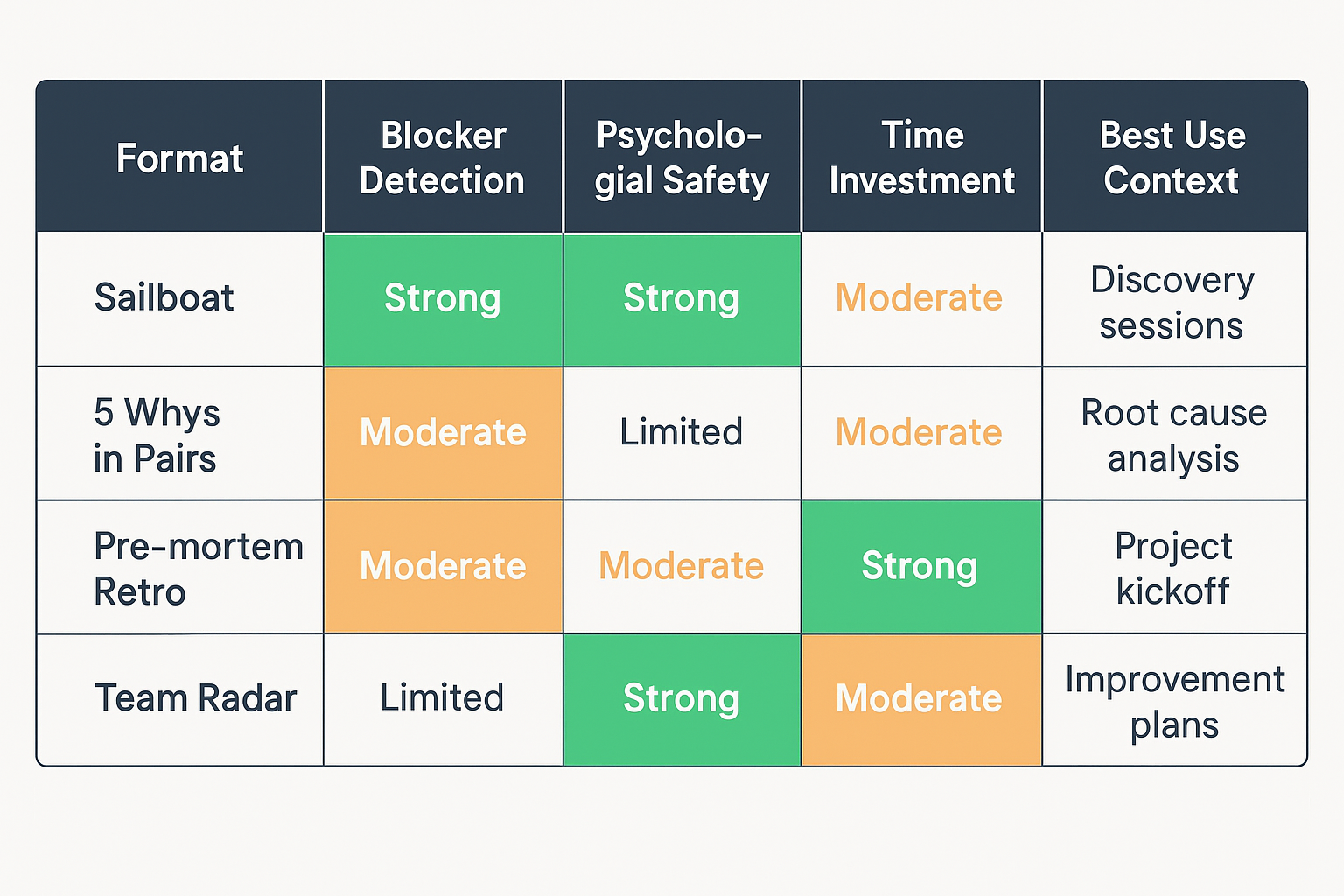
Choosing a Format
No single format works every sprint. The choice depends on what signal you are trying to draw out:
| What you need to surface | Format to use |
|---|---|
| Structural forces blocking delivery | Sailboat |
| Root cause beneath known problems | 5 Whys in Pairs |
| Risks and fears the team won't name | Pre-mortem |
| Where perception diverges across the team | Team Radar |
Rotate formats across sprints to prevent habituation. Teams learn to perform a familiar format rather than engage with it.
One More Thing
The format matters less than what you do with what it surfaces. A perfect retrospective format run by a facilitator who deflects difficult themes will still produce comfortable outputs and no change.
The formats above work because they create conditions for honesty. The Scrum Master's job is to create the safety that makes honesty possible -- and then to hold the team to the actions it names.
Agile Pulse goes out weekly -- practical guidance for Scrum Masters and delivery leads who want to lead, not just execute. Subscribe at indigo.pub to get it in your inbox.
Stay Current with Agile Pulse
Practical delivery intelligence for practitioners who want better sprints, better retros, and better standups. Weekly. Free.