How to Create a Value Stream Map Using AI Tools
Value stream mapping is one of the most useful delivery improvement techniques and one of the most rarely executed well. AI tools are changing both of those realities.

Value stream mapping is an analytical technique that many Agile teams understand in theory and rarely execute well in practice. The maps take time to construct, become outdated quickly, and require cross-functional participation that is hard to organize.
AI tools are changing the construction side of this problem. Here is a practical guide to using AI tools in the value stream mapping process.
What Value Stream Mapping Is Actually For
Value stream mapping identifies where time and effort are being consumed without adding value to the end customer. The waste is usually not in the work itself. It is in the waiting, rework, handoffs, and approval cycles that surround the work.
A good value stream map shows:
- The steps from idea to delivered value
- The time spent at each step
- The waiting time between steps
- Where rework occurs
- Where information becomes unavailable or ambiguous
The output is a clear picture of where the delivery system is losing time and effort.
Where AI Tools Are Useful
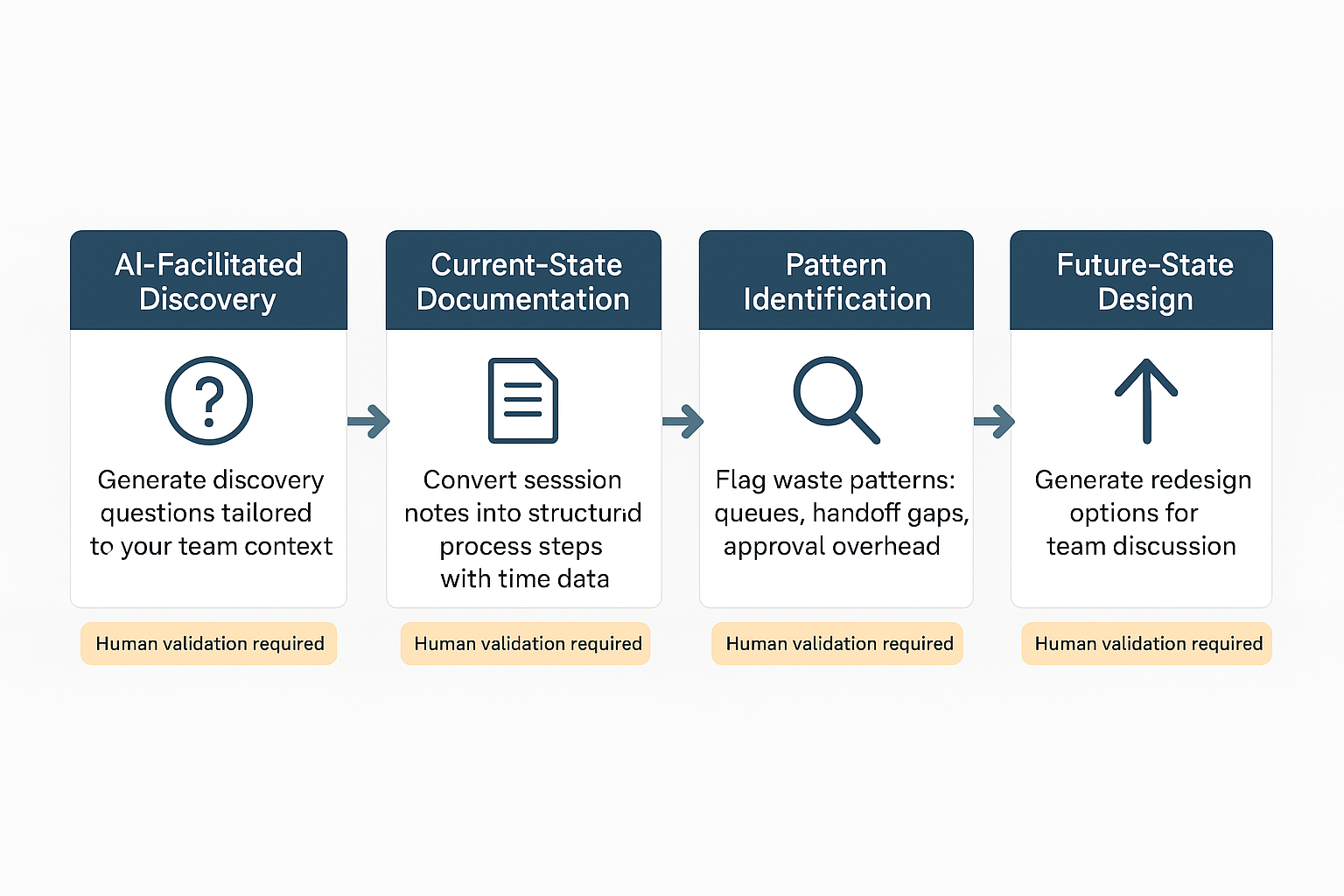
Facilitated Discovery
AI tools can help structure the discovery conversation that produces the raw data for a value stream map. A well-prompted AI assistant generates questions that surface the information the team needs:
- What triggers work to enter our process?
- What are the stages that work passes through before reaching the customer?
- How long does work typically spend in each stage?
- What are the most common reasons work waits between stages?
- Where does work get sent back for revision?
- Who needs to approve or review at each stage?
Use an AI tool to generate and refine this question set before the discovery session. Tailored questions produce better data than generic process workshops.
Current-State Documentation
After the discovery session, AI tools convert raw notes into structured documentation. A useful prompt pattern:
"This is the output from a value stream mapping session. Convert it into a structured list of process steps, each with: step name, inputs, outputs, typical duration, waiting time, key decision points, and common failure modes."
The output will need refinement. It provides a useful starting point that the team can edit rather than create from nothing.
Pattern Identification
AI tools can review the documented value stream and flag patterns that suggest waste:
- Steps with high waiting time relative to work time (queue accumulation)
- Handoffs that introduce information loss
- Approval gates that add time without proportional value
- Rework patterns that suggest upstream quality problems
Prompt the AI explicitly to look for these patterns. It will not surface them automatically.
Future-State Design
Once the current state is documented, AI tools generate future-state options. Provide the current state map and ask the model to suggest: which steps are candidates for automation, where handoffs could be eliminated, what the map would look like if waiting time were reduced by 50 percent.
Use this as discussion material for the team, not as a final answer.
What AI Tools Cannot Do
The limitation of AI in value stream mapping is the same as its limitation everywhere: it does not have access to the political and relational dynamics that explain why the waste exists.
Every value stream has inefficiencies that persist not because people have not noticed them but because changing them would require someone to give up control, authority, or the appearance of adding value. AI tools can identify the inefficiency. They cannot navigate the organizational politics of removing it.
That navigation is the Scrum Master's and coach's work.
A Practical Starting Point
For teams that have never done value stream mapping:
- Use an AI tool to generate a discovery question set customized to your team's context.
- Run a 90-minute team session using those questions to document your current delivery process.
- Feed the session output to an AI tool to produce a structured current-state summary.
- Review the summary as a team and identify the three biggest sources of waiting time.
- Design one experiment to reduce the largest waiting time by half.
This is not a comprehensive value stream mapping process. It is a practical entry point that produces actionable output without requiring weeks of facilitation.
Common Mistakes When Using AI for VSM
Accepting the AI's map as authoritative. AI produces a plausible structure based on what you give it. The team has to validate every step against actual experience. The map is a prompt for conversation, not a deliverable.
Skipping the political analysis. The AI identifies that approvals take three days. It does not know that those approvals are controlled by someone who uses them to maintain visibility. The coach has to identify that and decide how to address it.
Mapping once and forgetting. A value stream map is a snapshot. Delivery systems change. The map should be reviewed and updated whenever a significant process change occurs or every six months, whichever comes first.
Frequently Asked Questions
Do we need specialist VSM software to do this well?
No. A shared document with a structured template is sufficient for most Agile teams. Specialist software adds value when mapping complex multi-team value streams or when you need to calculate lead time ratios automatically. For a single-team exercise, start simple.
How long should a value stream mapping exercise take?
A focused exercise using AI-assisted facilitation can produce a useful current-state map in two to three hours. A comprehensive future-state redesign exercise may take one to two days across multiple sessions.
What is the difference between a value stream map and a process map?
A process map shows the steps in a process. A value stream map shows the steps AND the time, waiting, and flow data that reveals where value is being lost. The time dimension is what makes VSM analytically powerful.
Stay Current with Agile Pulse
Practical delivery intelligence for Agile practitioners improving delivery systems. Weekly. Free.