
Continuous Improvement: Why Impediment Removal Is the Scrum Master's Core Job
The difference between teams that plateau and teams that improve compoundingly comes down to one thing: whether impediment removal is tactical or systemic.

The Scrum Guide identifies impediment removal as a core Scrum Master responsibility. In practice, it is the most underdeveloped capability in the role.
AI tools can accelerate pattern detection across sprint data — surfacing recurring impediment types and frequency — but the system-level decisions that actually remove them still require human judgment and organizational authority.
Most Scrum Masters remove tactical impediments competently. They escalate the right issues, follow up on blockers, and keep the team from getting stuck on procedural problems. That is necessary work. It is not the work that determines whether a team improves over time.
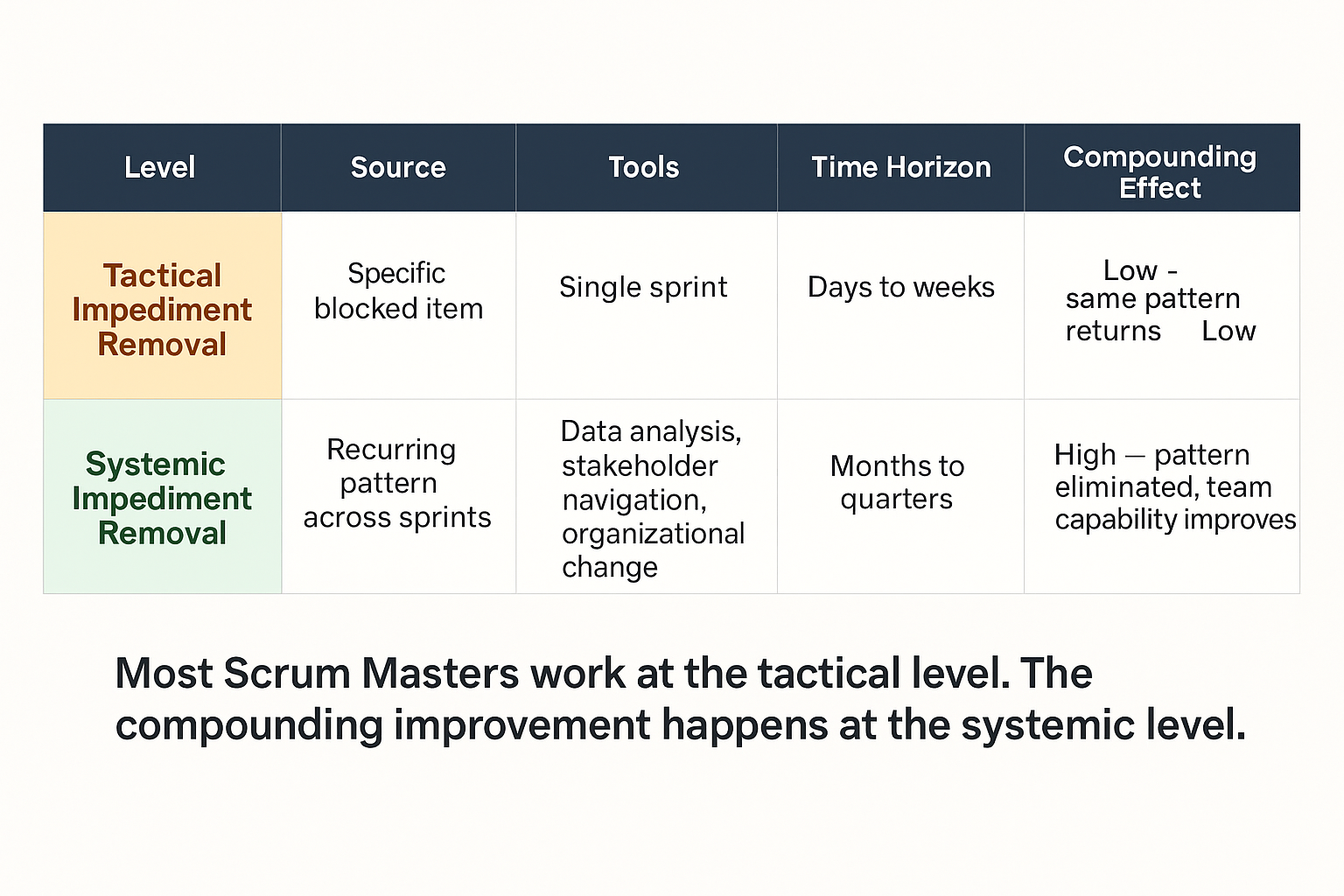
The impediment removal work that produces compounding improvement is at the system level. Here is the distinction and why it matters.
Tactical vs. Systemic Impediments
Tactical impediments are one-time problems: the server that needs access permissions, the stakeholder who has not responded to a question, the dependency on another team that needs to be negotiated for this sprint.
These get removed and do not return -- or they return in a different form. Either way, removing them is valuable but not compounding. The team gets past the immediate blocker.
Systemic impediments are the patterns that produce tactical impediments repeatedly. The reason access permissions are always requested at the last minute is a systemic impediment. The reason stakeholders do not respond in time is a systemic impediment. The reason dependencies are not surfaced until they are blocking is a systemic impediment.
The team removes the tactical impediment. The systemic impediment produces another tactical impediment next sprint. And the sprint after that.
Most Scrum Masters spend most of their impediment removal capacity on tactical impediments. The reason is visible urgency: the blocked item in front of them is concrete, the system behind it is abstract. The tactical blocker has a stakeholder waiting. The systemic problem has no one explicitly waiting for its removal.
How to Identify Systemic Impediments
The data source for systemic impediments is the retrospective, properly run. Not the retrospective that surfaces individual actions and assigns owners. The retrospective that identifies patterns across multiple sprints.
Useful questions:
- What types of blockers appear repeatedly across sprints?
- Which team dependencies are always the last to resolve?
- Which stakeholders are reliably difficult to reach when needed?
- Where does work always slow down, even when the immediate blocker is removed?
The patterns that appear across three or more sprints are the systemic impediments. These belong on a persistent impediment board, not the sprint backlog.
The Scrum Master's Removal Toolkit
Removing systemic impediments requires a different toolkit than removing tactical ones:
Organizational navigation. Systemic impediments often require authorization from people outside the team. This means knowing who has that authority, building relationships with those people, and making the case for the change. This is political work in the best sense: understanding organizational power structures and using that understanding to produce change.
Data-supported argumentation. "The team is frequently blocked on X" is less persuasive than "the team has experienced a dependency-related blocker on this service in 7 of the last 10 sprints, at an average cost of 1.5 sprint days per occurrence." Quantifying the cost of systemic impediments makes the removal case significantly stronger.
Persistent tracking. Systemic impediments do not get resolved in a single conversation. They require sustained pressure over multiple sprints. This means tracking them explicitly, referencing them in leadership conversations, and not accepting partial resolutions as complete.
Team coaching. Some systemic impediments are inside the team. A team that habitually starts new work when blocked is producing a systemic impediment through its own behavior. A team that avoids direct conflict with stakeholders is producing the communication gaps that create repeated blockers. Coaching the team's patterns is impediment removal at the behavioral level.
Continuous Improvement as a System
The distinction between teams that improve compoundingly and teams that plateau is whether they are removing tactical or systemic impediments.
Tactical impediment removal keeps the team moving. Systemic impediment removal changes the system the team operates in. Those are different outcomes.
The Scrum Master who spends the majority of their impediment removal capacity on systemic work is doing the work that compounds. The team they are working with in two years is materially different from the team in year one, because the system has changed -- not just because the team has gotten better at working within the same broken system.
This is the core of continuous improvement as a practice, rather than as a retrospective ritual. It is slower, more political, less immediately rewarding, and significantly more impactful.
Building the Systemic Impediment Practice
For Scrum Masters who want to shift from tactical to systemic focus:
Create a systemic impediment backlog. Separate from the sprint backlog. Items on this list are organizational or structural problems that require more than a single-sprint conversation to resolve. Review it every sprint. Track the age of each item. Old items with no progress signal insufficient organizational pressure or insufficient relationship capital to remove them.
Make the cost visible. Before escalating a systemic impediment, quantify it. How many sprint days has this impediment cost in the last quarter? What would the team's velocity look like if this impediment were removed? Numbers make abstract system problems concrete and defensible.
Set a resolution horizon. Systemic impediments should have a target resolution date. "This dependency issue will be resolved by Q3" is a commitment that can be tracked. "We are working on it" is not.
Report on impediment removal progress. Include systemic impediment status in sprint reviews. Stakeholders who see impediment removal as a tracked activity with measurable progress are more likely to support the organizational changes needed to resolve them.
Frequently Asked Questions
How do I convince leadership to prioritize systemic impediment removal?
Frame impediments as delivery risks with quantified costs. Leadership responds to business impact. "We lost 15 sprint days last quarter to dependency wait times on the authentication service" is a more actionable briefing than "we have dependency problems."
What do I do when a systemic impediment requires executive-level authorization that I cannot access?
Escalate with data and a specific request, not a problem description. "This impediment has cost 15 sprint days in the last quarter. The resolution requires X decision from Y executive. I am requesting a 20-minute conversation to present the case." Be specific about what you need and what it will cost to not get it.
How do I keep the team motivated when systemic impediments persist for months?
Make progress visible even when full resolution is not there yet. Partial improvements count. Acknowledge the frustration directly in retrospectives. Show the team that the impediment is being actively tracked and pressed, even if it is not yet resolved.
Stay Current with Agile Pulse
Practical delivery intelligence for practitioners building teams that improve over time. Weekly. Free.