Why Enterprise AI Projects Fail
You greenlit an enterprise AI initiative six months ago. The business case was solid.

You greenlit an enterprise AI initiative six months ago. The business case was solid. The vendor showed impressive demos. Your team was excited. Today, the project is three months behind, the data quality is worse than anyone expected, and your stakeholders are asking why the thing that was supposed to automate work is now consuming half your team's time just to keep it running.
You are not alone. Somewhere between 80 and 95 percent of enterprise AI projects fail to deliver meaningful ROI, and the failure usually happens quietly, months into execution, when the real technical and organizational constraints emerge. As a project manager, you are caught in the middle of this: expected to deliver something that was probably oversold, managing a team that may not understand the complexity, and working with data that nobody fully validated before you started.
The core problem is not that AI is hard. It is that enterprise AI projects are being scoped like software projects when they should be scoped like research. And when a PM treats discovery like a completed phase rather than a continuous gate, failure compounds silently.
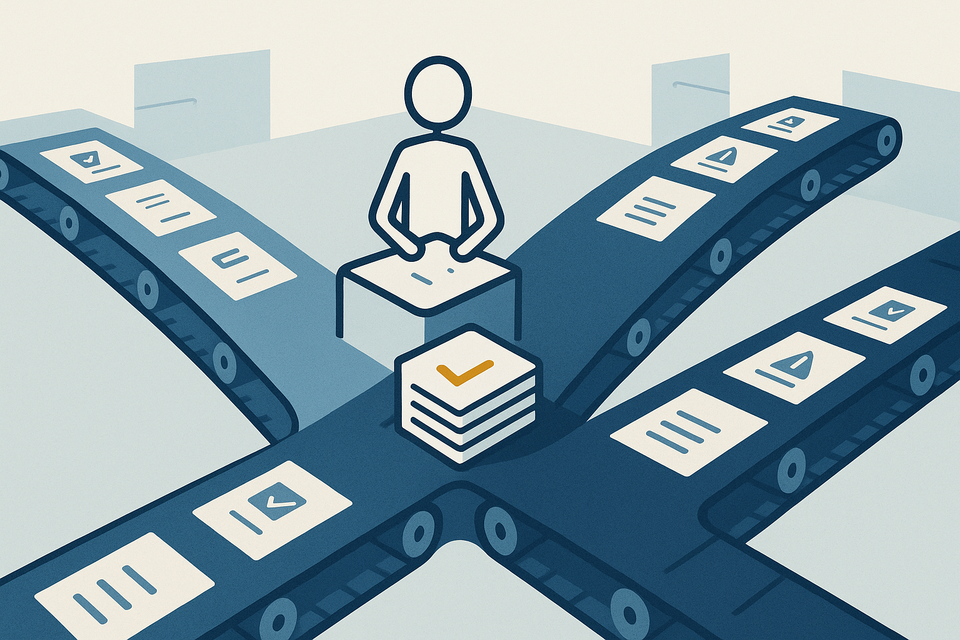
Here is what actually kills these projects. The first kill mechanism is scope creep that nobody sees coming because AI work feels different. When a team is building a feature in a familiar domain, boundaries exist naturally. When you are building an AI system, every stakeholder suddenly has ideas about what the model "could" do if it just learned this data set or included that variable. The scope expands without anyone formally changing it because the conversation feels like optimization, not addition. By the time you realize the project has doubled in complexity, you are already two sprints behind and your team is demoralized.
The second mechanism is data quality as an afterthought. Your data team told you the data was "mostly usable." That probably meant they could extract it, not that it was clean, consistent, or adequate for training. Most PMs inherit AI projects without ever asking: Has anyone actually audited the data? Are there missing values? Does the data reflect current business reality or is it two years stale? These are not nice-to-know details. They are delivery killers. A project can run for months on schedule before hitting a wall because the data was not what anyone thought it was.
The third mechanism is skills gap masquerading as scope. Your team may be excellent developers or analysts, but AI work requires a different kind of literacy. Someone on the team needs to understand what the model is actually doing, why it is failing on certain inputs, and whether a problem is a training issue or an architecture issue. Without that, you are managing timeline and budget against deliverables you cannot actually validate. You become a project manager with no way to assess whether the work is actually on track.
So how do you stay in control?
Start with a structured 30-day discovery gate before any real execution begins. Not a kickoff meeting. A gate. In those first 30 days, you audit three things. First, data readiness: pull samples, check for gaps, document lineage, understand how stale it is, and get explicit sign-off from data leadership that this is actually usable. Second, scope clarity: map every stakeholder request into one of three buckets: must-have for launch, nice-to-have for future, or out of scope. Write that down and get it signed. Third, team capability: identify who on your team (or external to your team) can actually validate model behavior. If nobody can, you have a blocker before you start.
Next, implement checkpoint-based governance at key inflection points. Do not wait for a full status report cycle to surface problems. Set three or four critical decision gates: data validation complete, model performance baseline established, integration testing completed, production readiness assessment. Before each gate, one person (often a technical lead, not the PM) validates that the gate criteria are actually met. Gates either close cleanly or escalate immediately. This prevents the slow-motion failure where projects drift months past their expected date because issues were never surfaced as blockers.
Third, be ruthless about scope. Every new request triggers the same conversation: Is this required for launch, or is it v2? Do not let "it would be easy to add" into your project plan. In AI work, nothing is easy to add once training has started. Scope creep is your biggest delivery risk, and the only person who can defend the boundary is you.
Finally, use your project tools to surface hidden problems early. If you are in Asana or Monday.com, build a custom dashboard that tracks three things: data quality status, scope additions logged and resolved, and blockers by category. This is not for the steering committee. This is for you. You should see scope creep coming three weeks before it becomes a crisis.
The hard truth is that many of the AI projects greenlit in your organization were sold before the real technical work began. Your job is not to fix the sales process. It is to make sure your execution stays grounded in what is actually possible.
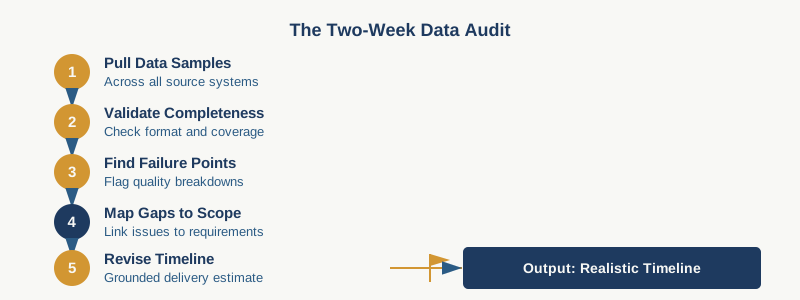
Before you staff your next AI project, run a data audit. Just do it. Spend two weeks pulling samples, validating quality, and understanding what you are actually working with. That one decision will tell you more about your real delivery timeline than any vendor estimate or business case ever will.
Practical AI intelligence for project managers. Weekly, free. Get frameworks, tools, and decisions that help you stay ahead of AI adoption on your projects. No hype. No filler. Subscribe free →
Stop writing from scratch. Get the 20 prompts PMs actually use for status reports, stakeholder updates, and retro summaries. Download free →