When AI Becomes a Crutch: What PM Overreliance Looks Like
There is a version of AI dependency that looks like productivity. Your meeting summaries are cleaner. Your status reports go out faster. Your risk register gets populated before you even think to open it. And then someone asks you a question you cannot answer without checking the tool first. That
There is a version of AI dependency that looks like productivity. You open a meeting, your AI tool starts summarizing. You pull a status report, your AI drafts it. You need a risk assessment, your AI populates the register. Everything moves faster. Your outputs look polished. You feel more on top of your work than you have in years.
And then someone asks you a question you cannot answer without pulling up the tool.
This is not a hypothetical. It is showing up in how PMs describe their own workflows now: a growing discomfort with not having the AI available, a reduced confidence in working from memory, a reluctance to offer a judgment until they have checked what the AI would say first. That pattern has a name in behavioral research. It is called cognitive offloading, and at a certain threshold it starts working against you.
The difference between a useful tool and a dependency
Every tool changes how you think. A calculator does not just compute faster than your brain. It changes which calculations you bother to learn. GPS navigation does not just route you more efficiently. It atrophies your spatial reasoning over time. This is not a flaw in those tools. It is how cognitive offloading works. You get efficiency gains and you pay for them in some form of reduced internal capacity.
AI tools in PM work follow the same pattern. Using AI to draft a status report is efficient. Using AI to draft a status report because you no longer feel capable of doing it yourself is something different.
The practical question is not "am I using AI?" The question is "what happens to my judgment when the AI is unavailable?" If the answer is "I slow down," that is fine. If the answer is "I am not sure I can do this without it," that is a signal worth paying attention to.
What overreliance actually looks like in delivery work
It rarely looks like an addiction in the way most people imagine. It does not feel dramatic. It builds quietly through small, repeated decisions to defer to the tool rather than think through the problem.
In PM work, it tends to look like this.
You stop forming your own read on a meeting before you check what the AI summarized. The AI summary becomes the record you work from, and your memory of what actually happened fades. Subtle dynamics, the stakeholder who seemed uncertain, the sponsor who qualified a commitment, the team member who went quiet when a deadline was mentioned, do not make it into the summary. Over time, you start missing things you used to catch.
You stop writing rough status reports before asking the AI to improve them. The rough draft is where you test your own understanding of the project. It is where you notice what you cannot explain clearly and where you are not sure of the data. Skip that step and the AI produces something that reads well but carries your gaps inside it, invisibly.
You start waiting for AI input before forming an opinion in stakeholder conversations. This one is the most consequential. PM judgment is earned through years of pattern recognition on stakeholder dynamics, risk signals, and delivery pressure. Deferring that judgment to a tool that has no relationship with your sponsor, no context on your organization's politics, and no investment in the outcome is a different category of risk.
What this means for you practically
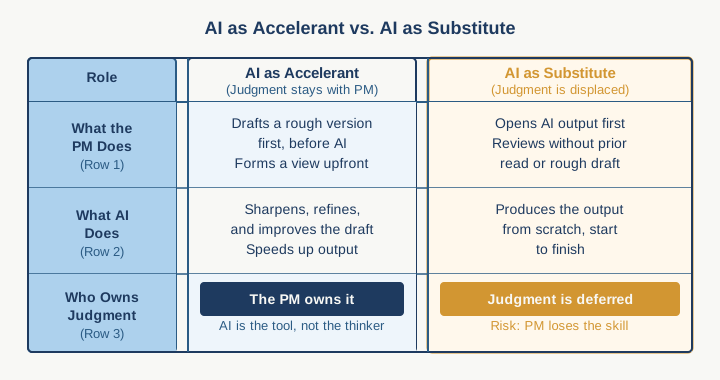
None of this means AI tools are bad for PM work. They are genuinely useful, and the efficiency gains are real. The point is to stay intentional about where your own thinking is in the loop.
Three questions worth asking about your own workflow.
Can you write a rough status report, or a rough read on a stakeholder situation, before you use AI to sharpen it? If the answer is yes, you are using AI as an accelerant. If the answer is no, that is worth examining.
When you receive an AI-generated summary of a meeting or a document, do you check it against your own recollection, or does the AI version replace your memory? If you are treating AI summaries as the primary record, you are probably missing signal.
When someone asks you an unexpected question about your project, what is your first instinct: to answer from what you know, or to check what the AI would say? This is not about speed. It is about where your judgment lives.
The practical discipline
The PM skills that matter most in high-stakes situations are the ones you build by doing the work yourself: forming an independent read on a situation before seeking input, writing a rough draft before polishing, noticing what you cannot explain before defaulting to a tool that makes everything sound coherent.
Use AI to go faster. Use it to catch things you would have missed. Use it to handle the drafting, the formatting, and the first pass on large documents.
But do not outsource the judgment. The steering committee does not need a polished AI summary. It needs your read on what is happening and what should happen next. That judgment is not replaceable, and it does not stay sharp without practice.
Practical AI intelligence for project managers. Weekly, free. Get frameworks, tools, and decisions that help you stay ahead of AI adoption on your projects. No hype. No filler. Subscribe free →
Stop writing from scratch. Get the 20 prompts PMs actually use for status reports, stakeholder updates, and retro summaries. Download free →