How to Assess AI Tool Risk Before Your Project Depends on It
Most project managers I talk to have already adopted at least one AI tool for their projects.

Most project managers I talk to have already adopted at least one AI tool. A chatbot for drafting status reports. An LLM for parsing meeting notes. Maybe something plugged into Jira for sprint summaries. The adoption happened fast, almost casually. Then came the harder question: should we actually be using this?
That gap between casual adoption and deliberate adoption is where most PMs get stuck. You know AI can save time. You are less certain about what risks you are taking on by using it, and you have no clear framework for deciding which AI use cases are worth the exposure and which ones are not. This is the real problem: you are making risk decisions about AI tools without articulating what risks you are actually measuring.
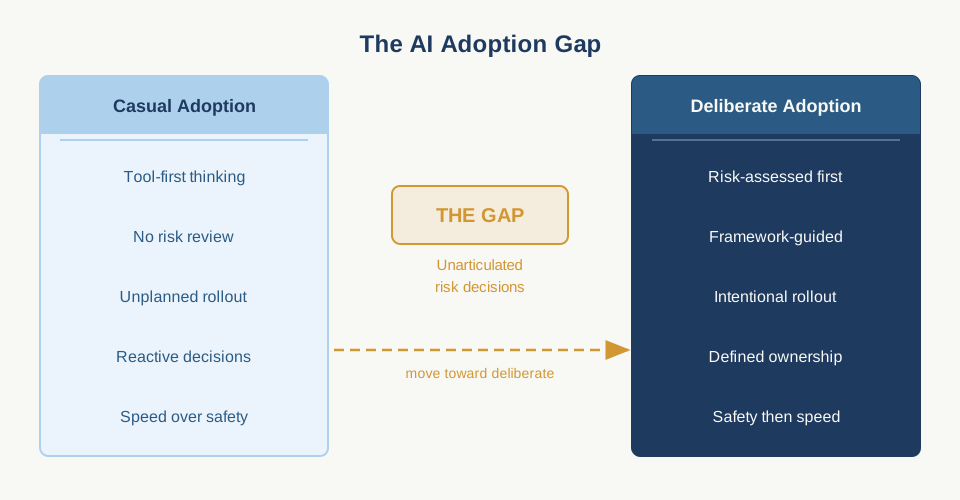
The risk calculus for AI in project management is not about whether the technology works. It is about whether using it in your specific context, with your specific data, creates more delivery problems than it solves. That calculation looks different depending on what you are asking the AI to do.
Consider the difference between two scenarios. In the first, you feed an LLM your project schedule, resource allocations, and budget data to generate a weekly status report for your steering committee. The AI does this well and saves you an hour per week. But it has also ingested sensitive financial and personnel information. If that data gets logged, retained, or used to train a model, you now have a compliance exposure you did not explicitly choose. In the second scenario, you use AI to draft non-sensitive project communication templates that you then edit and personalize. Lower stakes. Easier to govern. Same time savings, different risk profile.
Most PMs evaluate AI adoption the wrong way: they look at the time savings and ask if it is worth it. The better question is whether the use case falls within your organization's data sensitivity tolerance and whether the error rate of the tool is acceptable for that specific decision. A hallucination in a draft email is annoying. A hallucination in a resource forecast sent to finance is costly.
Here is a practical framework to think about this. Map each AI use case across three dimensions: Track the risks you identify in an AI risk register template for project managers to maintain a running record across your portfolio. data sensitivity (what information does the tool ingest), output criticality (how much does the organization rely on that output being accurate), and integration depth (how much automation or cascading decision-making sits on top of it). A high-sensitivity, high-criticality, deeply integrated use case (using AI to make resource allocation recommendations that automatically feed into timesheets and budget tracking) needs serious governance before you deploy it. A low-sensitivity, low-criticality, isolated use case (using AI to help brainstorm agenda topics for your next standup) barely needs governance at all.
The metric that matters most is not what the vendor claims the tool can do. It is your actual error rate in your actual context. Spend two weeks using the AI tool on real work. Count how many times you had to stop, rewrite, verify, or discard the output. If you are catching errors 15 percent of the time, the tool just became a filter, not a time saver. If you are catching errors once every hundred interactions, it is probably worth scaling.
Before you run a pilot, write down what would constitute a failure for that specific use case. Not a theoretical failure. A real one. "Using this for resource forecasting would be unacceptable if error rates exceed 8 percent and we discover this three weeks into the quarter." That clarity changes how you monitor the pilot. You stop asking, "Does this seem helpful?" and start asking, "Are we staying within the bounds we committed to?"
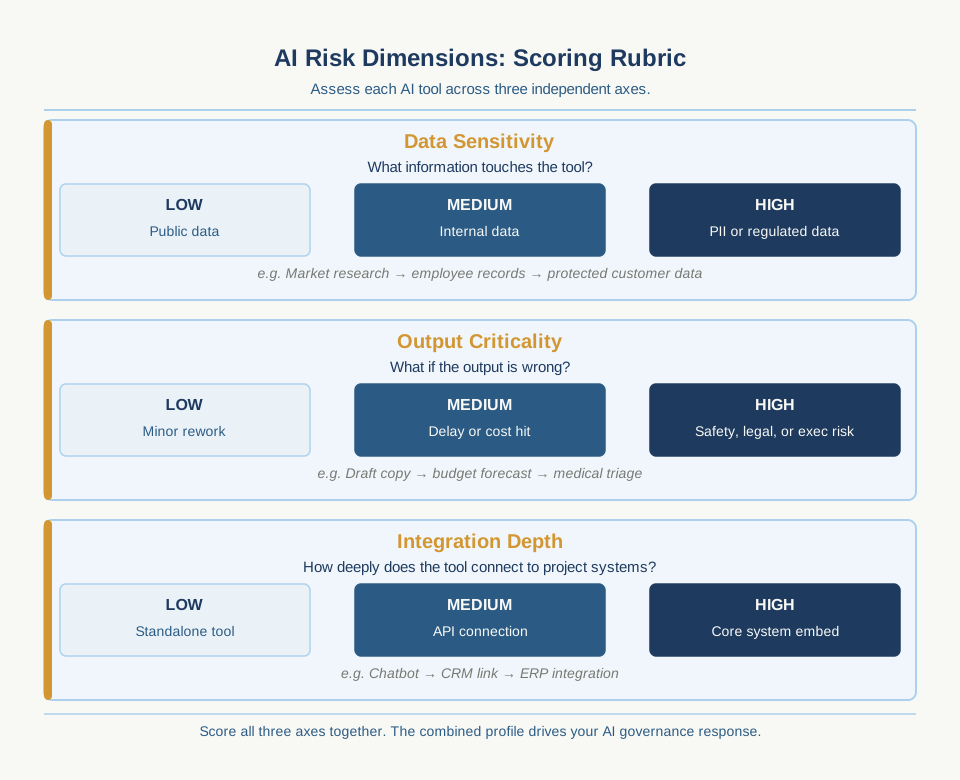
Build a simple governance checkpoint into your tool onboarding. Before any team member uses a new AI tool on project data, require a five-minute conversation: What data will this tool access? What decisions sit on top of it? What is our acceptable error rate? What happens if this goes wrong? That conversation takes longer than the time savings might be worth on day one. But it forces the risk calculus that most teams skip.
The organizations scaling AI adoption most effectively are not the ones moving fastest. They are the ones who started with a clear no. They said no to high-risk, low-benefit use cases and yes to low-risk, high-benefit ones. Then they let the pilots teach them where the real opportunities are.
Your next step: pick one AI tool your team is already using casually, and reverse-engineer its risk profile. What data touches it? What would happen if it got the output wrong? What compliance or security rules does it live in? Document it in five minutes. If you cannot articulate the risk, you have not actually decided to adopt it yet. You have just started using it. Work through each risk dimension using an AI project risk assessment checklist before committing to adoption.
Practical AI intelligence for project managers. Weekly, free. Get frameworks, tools, and decisions that help you stay ahead of AI adoption on your projects. No hype. No filler. Subscribe free →
Stop writing from scratch. Get the 20 prompts PMs actually use for status reports, stakeholder updates, and retro summaries. Download free →