
The Future of Scrum Masters in an AI-Integrated Delivery Environment
AI tools are handling ceremony scheduling, standup facilitation, and board hygiene. The Scrum Master role is not disappearing -- it is being clarified.

The conversation about AI and Scrum Masters has been running for three years. Most of it has been either reassurance ("AI cannot replace the human connection") or alarm ("automation will eliminate facilitation work"). Both responses miss the structural reality.
Here is what the Scrum Master role actually looks like in an AI-integrated delivery environment.
The Facilitation Layer Is Being Automated
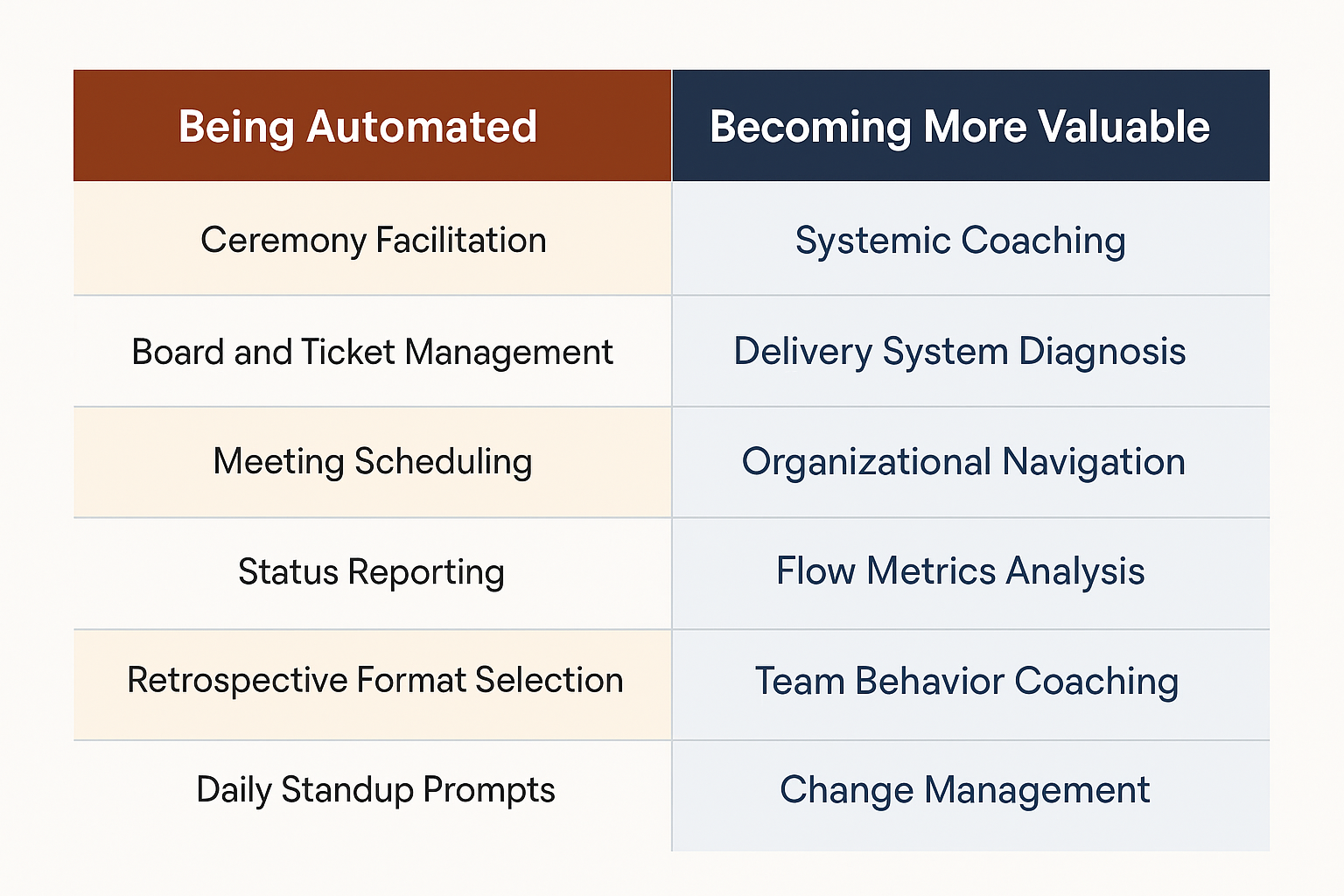
Ceremony scheduling, standup facilitation prompts, retrospective format suggestions, board hygiene reminders: these are being handled by AI tools in 2026. Teams that have adopted AI-integrated project management platforms are running lighter Scrum ceremonies with less manual overhead.
This is not an emergency. It is a clarification.
The time that Scrum Masters spend on ceremony management is being freed up. What that time gets spent on determines whether Scrum Masters become more valuable or less valuable in AI-native teams.
Three Roles That Become More Important
Delivery system diagnostician. As AI tools generate more data about how teams work -- flow metrics, cycle times, impediment patterns, meeting effectiveness -- someone has to interpret that data and make decisions about the delivery system. Scrum Masters with analytical skills and delivery system knowledge are positioned to own this interpretation layer.
Teams have always generated this data. Most of it has not been used. AI tools that surface it automatically create demand for practitioners who can act on it.
Organizational change navigator. AI adoption creates organizational change. Teams adopting new AI tools, adjusting workflows, and redefining role boundaries need people who understand change dynamics and can help teams move through them without losing delivery effectiveness.
Scrum Masters who understand organizational systems -- not just Scrum ceremonies -- are equipped for this work.
Coaching practitioner. The teams most disrupted by AI tools are the teams with the weakest collaborative foundations. When AI introduces new friction, teams without strong working relationships and communication norms struggle. Coaching that builds those foundations is more valuable in AI-native environments, not less.
What the Skills Gap Looks Like
For Scrum Masters looking to remain valuable, the transition requires specific capabilities:
Flow metrics literacy. Understand cycle time, throughput, and work-in-progress data. Know what changes in these metrics mean for the team's delivery system. Be able to have a conversation about metrics with engineering leads and product managers.
AI tool literacy. Know what AI tools are being used in your organization and how they change the team's workflow. You do not need to be a technical expert. You need to understand enough to coach teams through the adoption dynamics.
Systemic pattern recognition. The ability to see recurring patterns in team behavior and organizational dynamics is the core of coaching work. Develop a vocabulary for naming what you see.
Facilitation without dependency. Teams that cannot run their own ceremonies are a liability in AI-native environments where ceremony structures are evolving rapidly. A Scrum Master's goal should be to develop teams that do not need the Scrum Master to run every meeting.
What the Next Three Years Look Like
Scrum Masters in organizations with mature AI adoption will manage more teams, with lighter ceremony overhead, and deeper focus on delivery system health. The ratio of facilitation to coaching will shift significantly toward coaching.
Scrum Masters in organizations just beginning AI adoption will face more ambiguity and more change management work. The organizations that have invested in developing coaching-capable Scrum Masters will navigate this better than organizations that have not.
The role is not disappearing. It is changing in ways that reward depth over ceremony management.
A Self-Assessment for Scrum Masters
To understand where you sit on the facilitation-to-coaching spectrum, answer these questions honestly:
- If you were absent for a sprint, how would the team's ceremony quality change?
- When you remove a blocker, are you building the team's capacity to remove similar blockers themselves?
- How much of your coaching work happens outside the formal Scrum ceremonies?
- Can you name the three most significant systemic impediments affecting your team right now?
- Do you have relationships with engineering leads, product managers, and stakeholders outside the sprint ceremonies?
The answers tell you whether you are building toward the high-value version of the role or protecting the low-value version of it.
Frequently Asked Questions
Is it worth pursuing SM certifications if the role is changing so much?
Certifications provide foundational knowledge and professional credibility. They do not build the coaching capability that matters most in AI-native environments. Pursue certifications if the credential opens doors. Invest heavily in coaching practice, organizational systems thinking, and delivery analytics as the capability that determines your medium-term value.
How do I make the case to my organization for the coaching version of the Scrum Master role?
Use data. Show the correlation between delivery system health and business outcomes. When you remove a systemic impediment, quantify what changed: sprint predictability, cycle time, team capacity. The coaching investment case is easier to make when the outputs are measurable.
What happens to Scrum Masters who do not develop these capabilities?
The facilitation-only version of the role will continue to be eliminated, merged, or reassigned. This is not a prediction; it is a trend that is already observable in 2026. The timeline varies by organization size and Agile maturity, but the direction is clear.
Stay Current with Agile Pulse
Practical delivery intelligence for Scrum Masters and Agile practitioners navigating the AI transition. Weekly. Free.